

Table of Contents
How Did Artificial Image Generation Get Here?
From Imagination to Realisation
Artificial image generation was just a creative idea in the imagination of science fiction writers. Now, it’s a tool used by everyone. From the biggest corporations to the most unknown internet users.
Consider the trajectory. In 1968, Stanley Kubrick introduced us to HAL 9000. A terrifying, distant, purely speculative representation of what the future could be. In 1982, Blade Runner gave us the Esper Machine, which enhanced and generated photographic detail from minimal input. These were narrative devices, visual metaphors for technological anxiety. No one walked out of those theatres imagining they’d soon hold similar capabilities in their pockets. Yet, here we are. We are living through a moment when a capability shifts from specialist domain to general literacy.
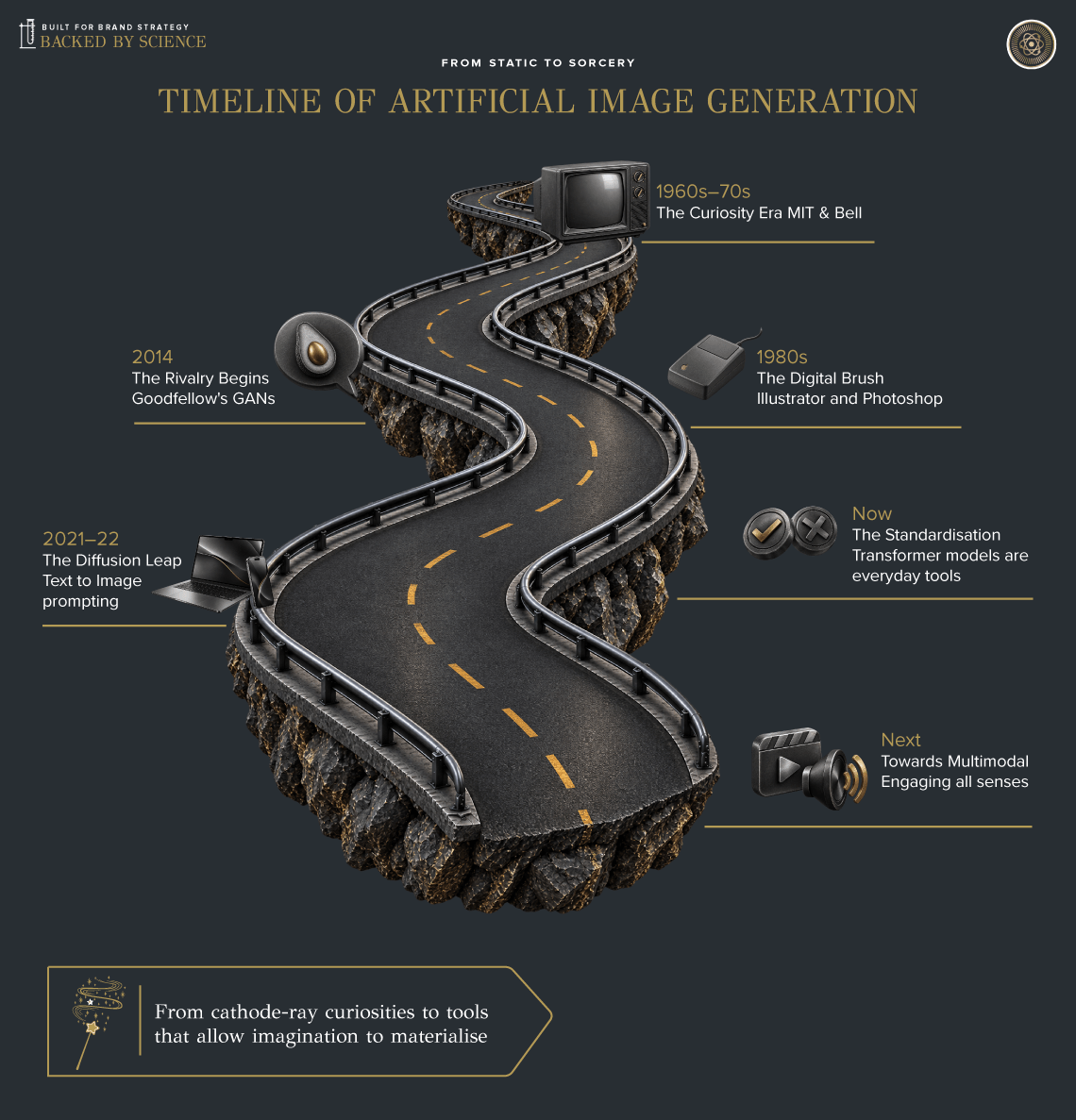
What began as a handful of glowing shapes on cathode-ray tubes has become a technology that turns a sentence into a photorealistic scene in seconds.
It starts in the 1960s and 70s, when researchers at MIT and Bell Labs treated computer graphics as a mathematical curiosity rather than a creative tool. The 1980s changed that: software like Illustrator and Photoshop put genuine creative power into human hands, though the computer remained a brush, skilled operators still did the imagining.
The real inflection point for artificial image generation arrived in 2014, when Ian Goodfellow introduced Generative Adversarial Networks (GANs), pitting two neural networks against one another in a kind of creative arms race. The results were often strange, sometimes uncanny, but undeniably novel. By the early 2020s, diffusion models took over, learning to build coherent images out of pure noise. Tools like DALL-E, Stable Diffusion, and Midjourney made this power available to anyone, regardless of technical skill.
Today’s systems, built on transformer architectures and trained on billions of image-text pairs, understand not objects but relationships. They’re not drawing, but interpreting style, composition, and consistency that we humans have created and refined. The easy path is passive adoption. The impactful path is intentional integration. This means choosing which human capabilities to preserve, which boundaries to enforce, and which creative standards to maintain.
Is Artificial Image Generation Actually Graphic Design?
Blurred Lines
Graphic design is fundamentally about problem-solving through visual communication. It requires understanding audience psychology, brand strategy, cultural context, and business objectives. A skilled designer doesn’t just make things look good, they make things work. They ensure a packaging design communicates trust on a retail shelf. They guarantee a website’s visual hierarchy guides users toward conversion. They maintain consistency across touch-points so brands become recognisable and memorable.
Current artificial image generation tools also struggle with precision. Text rendering remains inconsistent. Logos require exact proportions and colour values that generative systems often miss. Layout and typography-core graphic design competencies-are largely outside the scope of image generators, which produce raster images rather than structured design files.
However, dismissing AI as “not real design” is equally mistaken. The tools are evolving rapidly. Adobe’s Firefly integrates generative capabilities directly into professional workflows. Canva’s Magic Design generates layout suggestions. The boundary between generation and design is blurring as tools gain precision controls, style references, and brand kit integration.
Just like photography became an instrument in the late 19th century artificial, image generation is becoming a powerful instrument within graphic design. Celluloid did not replace canvas, but with this new technology, came new roles, new aesthetics, and new commercial applications. Similarly, artificial image generation is creating new specialisations while elevating the strategic aspects of design that remain distinctly human.
Does Artificial Image Generation Solve A Problem?
The Needs Addressed
The challenges that we are beginning to tackle using artificial image generation are different for each role within the branding and design ecosystem. We all know that our communication strategy needs a corresponding and complementary visual expression that is aligned to brand goals and the identity that our audiences have come to associate with that brand. So we must weigh the benefits because they come with corresponding trade-offs that could affect that relationship.
Marketers and creative teams face relentless pressure to deliver more assets across more channels with tighter budgets. Artificial image generation dramatically accelerates production timelines and speed allows agencies to present more concepts in pitch situations, increasing win rates. It also enables real-time personalisation generating tailored visuals for different audience segments without multiplying production costs.
The problem it doesn’t solve: strategic differentiation. When every agency has access to the same artificial image generation tools, the competitive advantage shifts from production capacity to creative strategy, audience insight, and brand understanding. Quality control and originality will alsobe a challenge. AI outputs reflect training data biases and common patterns. Creative directors must still curate, refine, and ensure work doesn’t feel algorithmic. The tools solve the volume problem but intensify the discernment challenge.
Holistic marketing designers who bridge strategy, identity, and creative visual execution will find AI most valuable in the middle of their process. It helps them visualise concepts for clients who struggle with abstract descriptions. It generates mood boards and reference imagery without stock photo limitations. It allows exploration of directions that would be cost-prohibitive to produce physically. However, it doesn’t replace the integrative thinking that defines big picture marketing design, which is the ability to connect business goals, user needs, and visual systems into coherent solutions.
So, we need to involve AI when we are facing production and exploration problems, not strategic or relational ones. A generative model will never understand a client’s unspoken concerns, navigate organisational politics with tact, or build the trust that leads to long-term creative partnerships. We need humans for that part.
Is There a Future for Artificial Image Generation?
JUST A PHASE, OR HERE TO STAY?
The way forward for brand managers in an AI-enabled world depends on how the industry adapts to consistency at scale, emerging brand systems, and the increase in value of human skills. Brand identity requires coherence across multiple touch-points, so the opportunity lies in developing systems trained on brand guidelines, capable of generating on-brand assets while maintaining flexibility. Treating AI as part of brand infrastructure requires translating abstract brand attributes (warm, innovative, trustworthy) into generative parameters. The designers who can encode brand essence into an artificial image generation systems will define the next era of identity design.
The most resilient approach treats AI as a collaborative partner with distinct capabilities. Humans provide strategic direction, emotional intelligence, and ethical judgment. The new tools provide variation, speed, and technical execution giving rise to new workflows that leverage both.
The future is moving towards brand identities that adapt to context while maintaining recognition. Folding in procedural design systems where artificial image generation systems handles adaptation while humans control principles. The final layer is building ethical frameworks for AI usage that become part of brand values. As technical execution becomes automated, these human skills will become more and more valuable:
- Strategic narrative construction
- Cross-cultural visual literacy
- Judgment and brand values alignment
- Creative direction and curation
- Systems thinking and design architecture
The organisations that thrive will be those that integrate AI into their unified brand approach thoughtfully and use the models available to amplify human creativity rather than substitute for it.
How Can Marketers Use Artificial Image Generation ?
SHIFTING PERSPECTIVES
At Nucleus Vision we have introduced Generative Workflows into our processes. They have assisted our teams in various ways.
1. Content Velocity
 Social media demands constant visual refresh. Artificial image generation has allowed our team to maintain posting frequency without exhausting creative resources or budget. On behalf of our clients we have generated seasonal variations, platform-specific crops, and A/B test visuals without multiplying production cycles.
2. Concept Visualisation
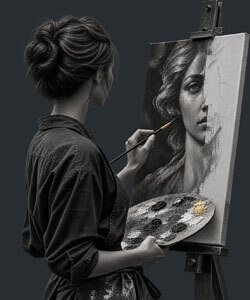 During a recent photoshoot one client was particularly budget conscious. So, before fully committing to an expensive production the Nucleus Vision team used artificial image generation to validate concepts. Will our model need a specific wardrobe. Do the chosen locations align with brand perception? Using these new methods and models provided new perspectives on the answers to these questions, and springboards for further creative decisions.
3. Personalisation and Localisation
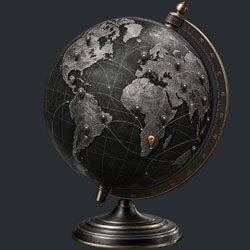 We have a handful of clients with a global presence. So be it in the East, West or in South Africa, the Rainbow Nation, certain campaigns are required to display cultural adaptation. The Nucleus team has experimented with modes that can generate region-specific imagery, and adjust models, settings, and visual cues to match whatever markets our clients need to be emerged in. This extends to demographic personalisation, which can create visuals that reflect diverse audience segments without separate photoshoots for each.
4. Rapid Prototyping
 For our SME clients who are unable to commit to large scale rebrands, but who are in need of website refreshes, landing page tests, or email campaigns, all benefit from quick visual iteration of artificial image generation. The models that Nucleus Vision uses enable our team to test multiple visual directions simultaneously, learning what resonates before investing time and resources from both our internal team and the clients we are serving.
5. Accessibility and Inclusion
Perhaps the most practical limitation is the simple shortage of time, talent and tools. Skilled graphic designers, illustrators and visual storytellers are in high demand and often overextended. Recruitment and training take time, and small teams struggle to meet the dual demands of volume and strategy. This scarcity is rooted in both industry growth and a talent pipeline that has not scaled to match demand. When creative bandwidth is limited, marketing ideas are either delayed or diluted, reducing innovation and performance. Artificial Image Generation serves as a force multiplier, enabling design teams to maintain quality while expanding their output.
Factors crucial to the success of these methods include maintaining human oversight for brand alignment, disclosing usage where transparency matters to audiences, and avoiding over-reliance that produces generic or misleading imagery.
Artificial Image Generation in Action
WALKING THE WALK: REAL WORLD EXAMPLES
So far, our discussion has focused on artificial image generation. But, the same concepts can be applied to video as well. As part of an holistic communication strategy content marketing plays an important role. And each team needs to find the way to produce that content that works for them.
The Nucleus Vision team makes use of various AI platforms like Higgsfeild, Magnific, and Replicate. These are platforms are the hubs for generative models. They are like a mall, and the generative models (discussed below) will be the shops you visit for that specific flavour, style, or story your’e looking for. Some of the below models, are available on multiple platform hubs. And each platform will give you access to multiple (many of the same, thought some different) models.
Artificial Image Generation In Action
Walking the Walk: Real World Examples
So far, our discussion has focused on artificial image generation. But, the same concepts can be applied to video as well. As part of an holistic communication strategy content marketing plays an important role. And each team needs to find the way to produce that content that works for them.
The Nucleus Vision team makes use of various AI platforms like Higgsfeild, Magnific, and Replicate. These are platforms are the hubs for generative models. They are like a mall, and the generative models (discussed below) will be the shops you visit for that specific flavour, style, or story your’e looking for. Some of the below models, are available on multiple platform hubs. And each platform will give you access to multiple (many of the same, thought some different) models.
Seedream
With strong relationships between references, this model is useful for developing consistent products, characters, environments and campaign worlds. It can be accessed through ByteDance’s Volcengine ecosystem and appears in platforms such as Higgsfield and Magnific. Its video counterpart, Seedance, extends similar multimodal capabilities into motion. Users praise it for speed with continuity. A visual concept can move through multiple executions, formats and assets without rebuilding the creative language.
Nano Banana
Available through Gemini, Google AI Studio, Vertex AI and Google Flow, with integrations across other creative tools, its strength is conversational visual manipulation. Users can generate an image, then instruct the model to change the setting, product, styling, composition or message while retaining important visual relationships. That makes it particularly useful when one core idea needs to become many executions. Meaning terations across environments and formats while remaining recognisably consistent. It suits large campaign asset libraries.
FLUX
This family of image-generation and visual-editing models is focused on controllability, photorealism, typography and reference consistency. Related tools can be accessed through the developer, Black Forest Labs, as well as platforms including Hugging Face, Replicate, fal.ai and Krea. Still other FLUX models can be integrated into professional creative software. Unlike a platform such as Midjourney, FLUX is particularly interesting when a designer wants to control an existing visual rather than simply explore aesthetics. Users report success when experimenting with product visualisation, controlled image editing and repeatable production workflows. Black Forest Labs does not currently offer a corresponding FLUX video model, so teams pair FLUX imagery with another video system for motion.
Recraft
This model approaches generative imagery through design systems. Available through Recraft Studio, its models can create raster and vector artwork, illustrations, icons, typography and assets conditioned around brand colours and stylistic consistency. Recraft Studio has also become a multi-model creative environment, bringing external video-generation models such as Seedance into the workflow. If the objective is an asset that belongs to a broader visual language, not merely an attractive picture try Redraft. Offering scalable creative production where consistency matters as much as novelty. It helps turn identity guidelines into practical assets at scale.
Midjourney
Midjourney is particularly strong for visual exploration because its strength is defining a creative territory. Its appeal lies in discovering unexpected combinations of atmosphere, composition, photography, art direction and visual storytelling. The Midjourney model is available directly through the Midjourney platform, and also offers Video V1 for animating generated or uploaded still images. Users can create a visual concept, then introduce motion and extend the resulting sequence. It is particularly useful as an explorative tool for imagining worlds, so can be useful with mood-boards, creative territories, experiential concepts and art-direction development.
Artificial Image Generation and Graphic Design for the Future of Digital Marketing
Where To Now?
The convergence of artificial image generation and graphic design is reshaping digital marketing in structural ways. Understanding this evolution helps organisations prepare rather than merely react.
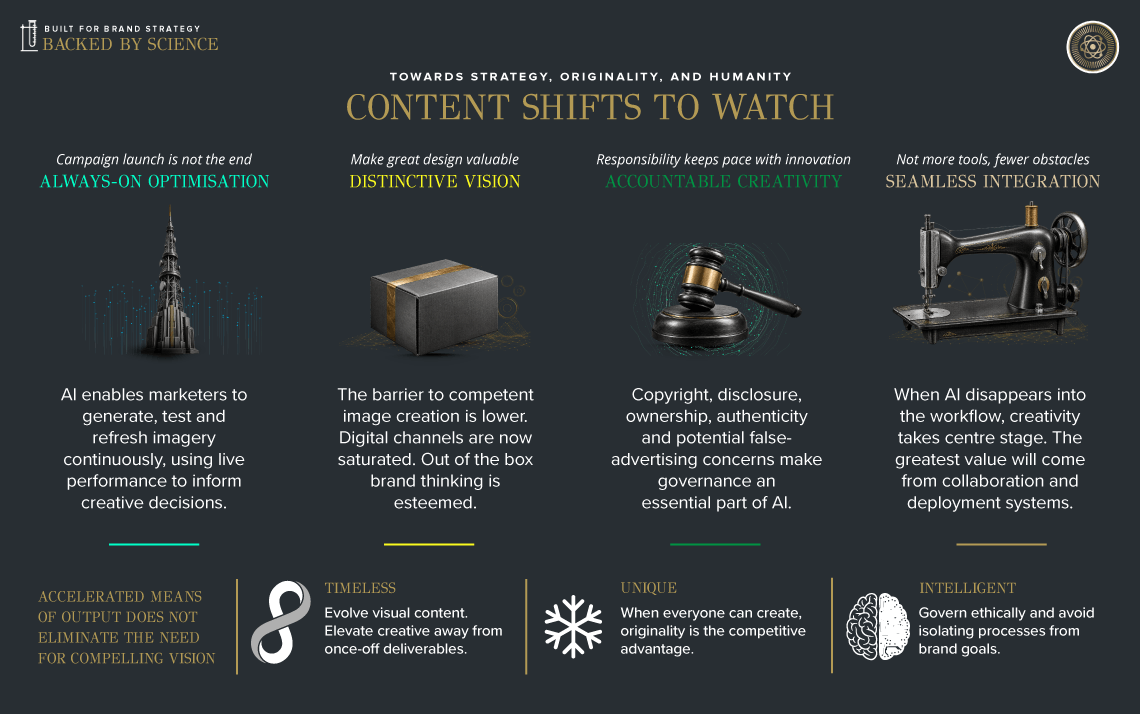
Campaigns once followed a linear cycle (brief, create, launch, measure). Now, AI-enabled workflows trend toward continuous optimisation. Generating, testing, and refreshing visuals in response to data and immediate feedback, rather then an end-of-cycle report. This accessibility creates yet another shift. As the barrier to producing competent visuals lowers, markets become saturated with content created by artificial image generation that is of an adequate standard. Not exceptional and not truly terrible. So, uniquely distinctive design is becoming more valuable, not less.
The marketers and designers who develop these capabilities while leveraging emerging technologies for execution will define the next era of digital marketing. Those who compete on technical production alone will face commoditisation. The organisations that thrive will be those that integrate AI thoughtfully: maintaining human judgment at strategic levels, using generative models for scale and variation, and developing new competencies around curation, ethics, and systems thinking.
As an industry and ecosystem of professional marketing communicators, we can refuse to let technological capability define creative possibility. Driven by a belief that graphic design and brand identity, approached as unified forces, can be strengthened rather than diminished by intelligent tools like artificial image generation, and AI video models and platforms. Who understand that the most profound impact comes not from generating more images, but from generating better ones that communicate, persuade, and connect because thoughtful humans directed their creation.
The science fiction writers imagined machines that could see. We now live in a world where machines can generate what they never saw. The next chapter belongs to those who decide what that generation is for.
Updated: October 23, 2026
