

Table of Contents
AUTOMATION IN SERVICE OF AI AND HUMANS
Why wellbeing comes before efficiency
We have been teaching machines to make our lives easier for decades, from calculators to corporate software, and this long relationship between AI and humans (often not thought of as “AI” but just simply technology) can now mature into something more consciously human centred when it is understood as a pathway to greater wellbeing and fulfilment, rather than simply as a productivity tool. When we frame automation as a way to support human quality of life, we begin to see that its real promise lies in freeing people from the weight of constant busyness, allowing them to live and work with more presence, intention, and joy. In this view, wellbeing comes before efficiency, and productivity becomes one important, but secondary, outcome of a more balanced relationship between AI and humans.
Within this relationship, the shared effort to seek out automation can dramatically reduce cognitive overload, repetitive labour, and decision fatigue. AI systems process information at speed, handle routine tasks, and surface patterns in data, so that the human mind is no longer stretched to breaking point by endless micro decisions and mechanical work. As cognitive overload and repetitive labour decrease, people gain back mental and emotional bandwidth. This reclaimed energy can then be redirected toward creativity, connection, and meaning in personal and social lives. Instead of spending the best hours of the day wrestling with administration, humans can use AI as a partner that prepares the ground for higher level thinking, imaginative exploration, and deeper collaboration with others.
Only secondarily does this perspective turn to workplace efficiency, and even then, productivity is positioned as a beneficial byproduct rather than the primary goal of automation. When people feel less decision fatigue and more fulfilment, they naturally become more focused, inventive, and resilient in their work. Teams that use automation to clear away low value tasks are able to invest more attention in strategy, problem solving, and human centred design, which in turn improves outcomes for organisations and communities. In this way the relationship between AI and humans is in service of wellbeing first and allows productivity to follow, creating a healthier, more humane model of progress where technology supports, rather than competes with, what makes us deeply and distinctively human.
CONNECTING AI AND HUMANS
The hidden costs of a fully manual world
In a completely unautomated world, individuals would shoulder every aspect of task management, information processing, and administrative burden alone. Remember tools like the calculator are “pre AI” automations that we now take for granted, yet they once represented a profound reduction in mental strain. Without such tools, every calculation, every schedule, and every repetitive task would demand fresh cognitive effort. Over time, this constant demand would create emotional strain as people try to keep up, leading to a sense of always being behind, always juggling, and never quite catching their breath.
On a cognitive level, the absence of automation would intensify overload and decision fatigue. Human minds are wonderfully capable, but there is inevitable strain that comes along with processing endless streams of detailed information without rest or support. A curated relationship between AI and humans can mean that routine and repetitive tasks are handled automatically so that uniquely human creativity can take root and grow. In a fully manual world, that methaphorical soil would remain compacted by constant micro decisions and mechanical labour, leaving little space for deep thinking or imaginative problem solving to thrive. People would spend much of their mental energy on checking, rechecking, and organising, rather than on exploring new ideas, learning new skills, or engaging in complex challenges that require focus and reflection.
Socially, these burdens would show up as reduced time and capacity for human connection. If every hour is absorbed by administrative burden and information processing, there is less room for meaningful conversations, collaborative work, and community building. When AI helps with routine tasks, it can actually foster increased collaboration, interdisciplinary work, and human centred design. Without that support, personal growth and collective progress would be constrained, because individuals would struggle to step back, reflect, and engage with others in deeper ways. The calculator, and other “pre AI” automations we now barely notice, reminds us that connecting AI and humans is not about replacing human ability, but about relieving unnecessary strain so that emotional, cognitive, and social energy can be invested in what truly matters.
HESITATION AT THE BOUNDARY BETWEEN AI AND HUMANS
Why applying AI in branding still feels complex
Many anxieties about artificial intelligence come from misunderstanding what “artificial” really means, and from imagining that machines are somehow acting independently of human intention. In branding projects, this can translate into a fear of loss of authenticity, as if using AI for insight, content, or personalisation might make customer engagement feel mechanical or insincere. Professionals who care deeply about brand values and emotional resonance can feel uncertain about how to let algorithmic insight play a role without compromising the human spirit of their work, which is why exploring the relationship between AI and humans in a branding and marketing context is still met with trepidation at a practical level.
There is also a genuine concern about ethical responsibility, creative ownership, and over reliance on technology. When AI tools are used to generate ideas, concepts, and even full campaigns, brand teams may ask whose voice is speaking and who is ultimately accountable for the impact of that communication. AI can only work with what humans give it and that it is best understood as a fast assistant handling routine and repetitive tasks, rather than as an independent creative director. Yet in the day to day reality of deadlines and high expectations, it can be tempting to lean too heavily on AI outputs. This creates a tension at the boundary between AI and humans, because marketers want the benefits of speed and scale without losing the sense that their brand stories are crafted with care, empathy, and genuine human insight.
AI is exceptionally good at processing vast amounts of data, searching for patterns, identifying trends, and predicting preferences, while humans excel at critical thinking, emotional understanding, and creative problem solving. Many professionals find it difficult to translate the benefits of the relationship between AI and humans into practical branding tactics that feel emotionally genuine and aligned with brand values. They are still learning how to let AI “sow the soil” for creativity without allowing it to overshadow human judgement. The path forward lies in treating AI as a collaborator that reduces cognitive load and administrative pressure, while people remain the authors of meaning, tone, and ethical direction. When this balance is consciously maintained, applying AI in branding becomes less about crossing a boundary and more about strengthening the partnership between human intuition and algorithmic insight in service of more authentic, human centred brands.
AI AND HUMANS ENHANCING EXPERIENCES
Learning from other human centred industries
There are real world examples where the relationship between AI and Humans has been successfully leveraged to strengthen, rather than replace, human interaction. In healthcare, AI supports patient monitoring through remote patient monitoring systems that analyse continuous data from wearable devices and home sensors, helping clinicians spot trends, detect risks early, and adjust treatment plans while still keeping the human practitioner at the centre of care. AI can be assembled to take over routine and repetitive tasks so that humans can focus on deeper problem solving and creativity, and healthcare shows this very clearly when clinicians use AI as an assistant that watches quietly in the background, freeing time and attention for more compassionate, face to face conversations with patients.
Education offers equally encouraging examples of personalised learning that remain deeply human. Tools such as Khan Academy’s Khanmigo are designed as tutors and teaching assistants that guide learners through questions rather than simply handing over answers, helping teachers streamline preparation while also offering students tailored support. In mental health, AI powered mental health tools such as Wysa and Woebot provide accessible, evidence informed support between sessions, offering mood tracking and coping exercises while research emphasises that these tools work best as supplements to human therapists rather than replacements. Accessibility focused industries extend this pattern through assistive technologies such as Microsoft’s Seeing AI, which narrates the world for people who are blind or have low vision, making everyday tasks such as reading labels or recognising faces more independent while keeping human relationships and community at the heart of life. In each of these examples, thoughtful implementation prioritises human dignity, trust, and empowerment, and uses AI to open doors that were previously closed.
For marketers, these industries provide valuable parallels for designing AI enabled brand experiences that remain deeply human. Healthcare, education, and accessibility all show that when AI reduces cognitive load, handles background processing, and offers patient monitoring, personalised learning, mental health tools, or assistive technologies, humans gain more space for empathy, creativity, and presence. Brands can approach the relationship between AI and Humans in the same spirit, using AI to handle data analysis, pattern recognition, and routine communication, while reserving human effort for storytelling, ethical judgement, and genuine connection. When marketers design AI enabled journeys that respect human dignity, reinforce trust, and invite empowerment, they mirror these real world examples and demonstrate that AI and humans can work in tandem to create a practical pathway to brand interactions that feel more caring, more intelligent, and more profoundly human.
THE AI AND HUMANS PARTNERSHIP
Harmony between intelligence and empathy
A future where the best-case outcomes of a balanced relationship between AI and humans is realised would feel quietly but profoundly different from today. In this future, the AI and humans partnership creates harmony between intelligence and empathy, so that technology works in the background to carry complexity, while human beings stand in the foreground with more presence, clarity, and care. What are some key elements of this future?
Increased Emotional Capacity

In a world where the relationship between AI and humans is cultivated, intelligent systems take on much of the constant task management and information sorting that currently fills human minds. By reducing cognitive load, AI tools free individuals from the draining effort of managing endless details, reminders, and low-level decisions. This creates increased emotional capacity, because the mind is no longer in permanent survival mode. People have more space for patience, generosity, and empathy, both at work and in their personal lives. Harmony between intelligence and empathy emerges when AI holds the mental scaffolding and humans can focus on the emotional heart of interactions, whether that means listening more deeply to a client, being present with a child, or engaging fully in creative collaboration.
Personalisation Without Intrusion

When the relationship between AI and humans is balanced, deeper personalisation becomes possible without crossing into intrusion. AI can interpret patterns in preferences, behaviours, and contexts, then quietly shape recommendations, timing, and content so that experiences feel surprisingly relevant. The key is that humans design the boundaries and values, ensuring that personalisation respects consent, privacy, and emotional comfort. In this way, AI helps create experiences that feel made for the individual, while humans provide the ethical frame and sensitivity. The outcome is a form of personalisation that feels like thoughtful service rather than surveillance, supporting trust and long term relationships in branding, education, healthcare, and everyday life.
Intelligently Supported Creativity

Enhanced creativity is another major benefit when AI and humans work in partnership. Intelligent systems can act as research assistants, pattern finders, and rapid prototyping companions, offering starting points and variations that spark new ideas. Humans then bring intuition, taste, and emotional depth to choose, refine, and transform those ideas into meaningful work. This harmony between intelligence and empathy means that AI does not replace creative ownership, but extends the range of what is possible within the same amount of time. Teams can explore more concepts, test more narratives, and push further into imaginative territory, knowing that AI is there to handle repetitive tasks and heavy analysis while they focus on craft, story, and symbolism.
Adapted Inclusive Experiences
More inclusive experiences arise when adaptive systems use AI to respond to diverse needs in real time. Interfaces that adjust to different abilities, languages, and sensory preferences can make participation easier for many more people. For example, AI can support real time captioning, alternative text descriptions, adaptive layouts, or personalised learning pathways that honour different paces and styles. Humans define the principles of inclusion and accessibility, while AI provides the flexible infrastructure that brings those principles to life at scale. In this way, the methods that AI and humans use to work together help remove barriers that once seemed fixed, allowing communities, brands, and institutions to welcome participation from people who were previously overlooked or underserved.
Work and Wellbeing Alignment
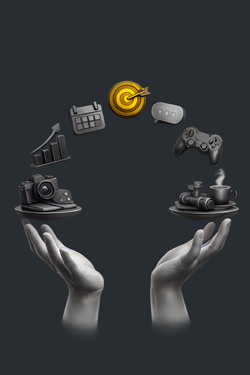
Greater alignment between work and wellbeing is a natural outcome when AI absorbs repetitive labour and decision fatigue. In this future, people do not feel forced to choose between productivity and health, because the design of systems recognises that sustainable performance depends on humane conditions. AI can help schedule work in more realistic ways, flag overload, and streamline processes, so that human time is spent on tasks that carry meaning and value. Leaders and teams can use insights from AI to design roles and workflows that respect human limits and strengths. The result is workplaces where individuals feel supported to grow, rest, and contribute, reinforcing the idea that wellbeing is a foundation for long term success, not a luxury.
In this vision, the connection between AI and humans is an amplifier of human strengths, not a substitute for them. AI contributes speed, scale, and pattern recognition, while humans bring empathy, ethical judgement, and creative insight. Harmony between intelligence and empathy becomes the measure of good design, and balance becomes the guiding principle for future innovation. When that balance is honoured, AI does not make life colder or more mechanical. Instead, it creates conditions in which people can live, work, and relate with greater presence, kindness, and purpose, allowing the best of both AI and humans to shape a more humane future together.
THE FUTURE OF AI AND HUMANS
Hope, agency, and intention in the age of AI
After all of this, there is a central question to consider: are machines are making us more human? AI is not an independent force, but an extension of human capability, designed and directed by people to reduce repetitive work and cognitive strain. Every automation tool form the seemingly humble calculator, to the fast becoming ubiquitous image generation software, all exist because humans can already perform the underlying tasks, and have simply built machines to do them faster and at scale. When seen in this light, hope, agency, and intention in the age of AI can come into clearer focus. The more consciously we use automation to relieve routine pressure, the more space we create for empathy, imagination, and deeper human connection in both life and work.
For marketers and brand managers, this perspective opens a hopeful way of seeing AI and humans as partners in creating more meaningful, empathetic, and fulfilling brand experiences. The article emphasises that AI can analyse data, search for patterns, identify trends, and predict preferences, while humans remain responsible for critical thinking, problem solving, and creativity. In branding, this means that AI can prepare insight rich ground for strategy and storytelling, while people craft the tone, values, and emotional nuance that make a brand feel alive. Rather than fearing loss of authenticity, professionals can approach AI as a collaborator that helps them understand audiences more deeply, personalise with sensitivity, and design experiences that feel both intelligent and sincerely human.
Updated: 27 Feb 2026
