



Table of Contents
The Widening Gap Between Sales And Marketing Work
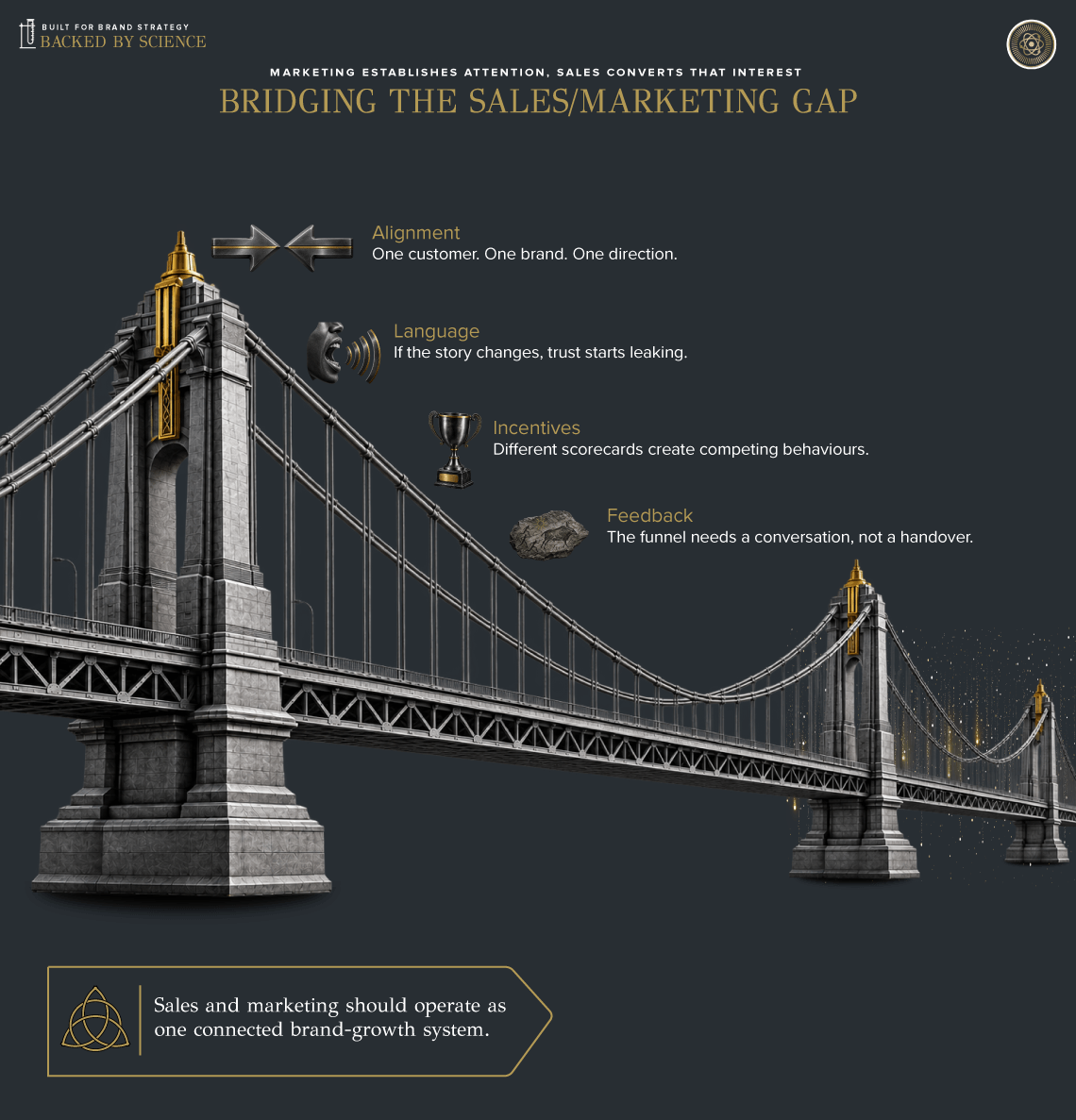
AGREEING ON A COMPASS
From Fortune 500 giants to family-run corner shops, the two crews of sales and marketing work aboard one ship. Balance sheets may differ. Quarterly earnings may rise and fall. Buyer personas will fall across the spectrum. The symptoms of misalignment, however, are stubbornly universal.
Marketing work increases lead volume that sales teams don’t perceive has having that closeable quality. Customers receive messages that contradict one another like rival weathervanes on the same roof. No single thing has gone wrong. Instead, a procession of unfortunate events lets revenue seep from the funnel, and nobody can quite locate the leak. It is tempting to treat this as a commercial inconvenience, a spreadsheet puzzle awaiting a cleverer formula. It is not. The deeper cost is cultural.
Social psychologists have long observed that humans form in-group loyalties with startling ease, sometimes on the flimsiest of pretexts. Give a team its own targets, tools and vocabulary, and it will soon regard the neighbouring department as a foreign country. We also have a habit of excusing our mistakes by pointing to circumstances while overlooking the pressures shaping the other teams. People tend to do what they are rewarded for. If marketing is measured on quantity and sales on closed deals, both are behaving perfectly rationally. They are simply using different tools to navigate to the destination. Now, the navigation device does not row the boat. It simply ensures that every oar pulls towards the same horizon.
Without a unifying compass, sales and marketing may each work diligently and still arrive somewhere nobody intended. Since marketing owns the long-term brand narrative, marketing work can give both teams common definitions, common goals and a common picture of the customer. This is not a demand that sales and marketing become identical, it is simply a call for commitment. Both need to agree on where true north lies, so that the difference between sales efforts and marketing work becomes the wind in the sails, rather than the anchor holding them down.
Blindspots That Undermine Sales and Marketing Work
INVISIBLE HURDLES
Like dominoes leaning on a slope, the components that compound into the obstacles holding sales and marketing work from success all reinforce each other.
It begins with structure. Separate reporting lines, divergent incentives and unequal boardroom status mean the teams are rewarded for different outcomes. Sales is paid to harvest this quarter; marketing is asked to sow for next year, then scolded when the soil looks bare. This architecture tilts both crews towards short-term conversion and leaves brand building perpetually underfunded.
Divided structures soon produce divided language. Without a common definition of a qualified lead, an ideal customer or a successful handover, the sales team could come to view the marketing work as a misapplication of resources. Gaps in vocabulary are mirrored by gaps in data. Each teams measures their success, and the others’ perceived failure with different rulers, which makes budget arguments unwinnable and shared accountability impossible.
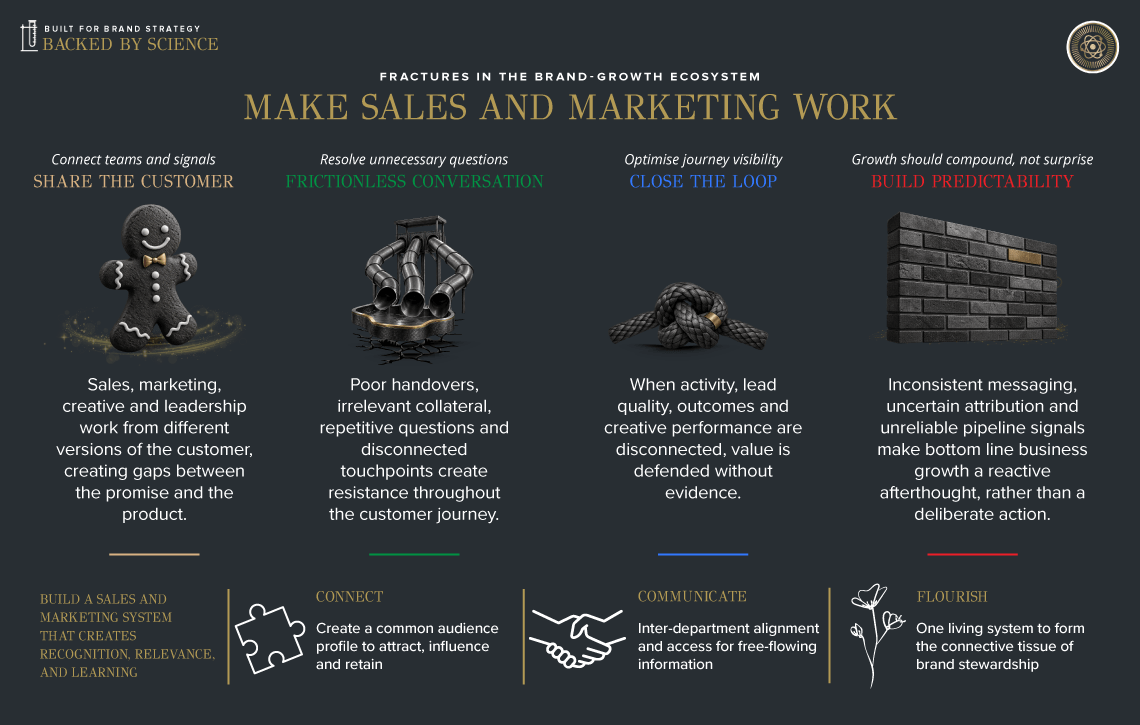
The customer feels the consequences first. A fractured path to purchase, collateral that sales disregards and inconsistent messaging all create friction. Meanwhile, delighted clients who could champion the brand remain an untapped treasure chest, because neither team is using advocacy as a metric.
A singular challenge crystalises: two teams charting their own parts of a journey that the customer encounters as one fragmented experience. So between the sales efforts and the marketing work neither team is hitting their targets. The remedy begins where the trouble does, with shared goals, shared definitions and shared data, sustained by leaders who reward the ship’s arrival rather than either crew’s rowing.
Marketing Work That Supports Sales Outcomes
RECONNECTING BROKEN CIRCUITS
The big divergence between sales efforts and marketing work are that they require distinct skills, operate on different time horizons and are often rewarded for different outcomes. This divide contributes to real friction for all the players involved.
Sales teams are frustrated by leads that arrive cold, collateral that answers questions nobody asked and prospects who know little about the brand before the first call. A satisfying solution delivers warmer, better-qualified conversations, content shaped by frontline objections and buyers who arrive already half-persuaded.
Marketing teams chafe at invisible impact, unrecorded lead outcomes and budgets defended through guesswork. Their ideal is a closed feedback loop showing which activity generated revenue, enabling smarter investment and earning genuine credibility at the leadership table.
Customers endure repetitive questions, contradictory messages and a journey that lurches between helpful and haphazard. What they want is disarmingly simple: one coherent conversation, relevant information at each stage and a sense that the company remembers them.
Leadership and finance wrestle with unpredictable pipelines, murky returns and interdepartmental quarrels that consume management attention. A satisfying solution provides dependable forecasts, transparent attribution and growth that compounds rather than lurches.
Placed side by side, these wishes rhyme. Sales wants better conversations, marketing wants proof of contribution, customers want coherence and leadership wants predictability. All four are served by the same mechanisms: agreed definitions of a qualified opportunity, shared data tracing each account from first touch to renewal, content co-created from real customer insight, and joint targets tied to revenue and retention rather than departmental activity.
Picture a loaf of sourdough. The crust is what misaligned teams experiences daily. The toughness of missed handovers, unfollowed leads, stalled deals, and meetings where pipeline figures become ammunition. It is hard and noisy and the first thing anyone touches.
Culture is baked in when we invite our sales and maketing teams to experience wins together. Every contribution from first impression to signed contract. Colleagues who used to argue only need to break through the tough exterior to discover they were collaborating all along.
Nobody needs a new recipe, merely a warmer oven. The friction, then, could be percieved as superficial, a crust of miscommunication over a soft spongy crumb of alignment and shared goals. Separately, sales efforts and marketing work are already planning a journey to the same destination. What they lack is a shared map, and marketing is well placed to create it.
Borrowed Wisdom for Better Marketing Work
UNLIKELY MENTORS
Sales and marketing teams are not the only ecosystems that encounter the problem of having something to sell, but not knowing how to navigate towards their target audiences. Marketing work can take lessons from many other disciplines.
City planners have long observed “desire lines”, the worn tracks pedestrians carve across grass. Official paths often ignore how people actually move, so keen observation is required to give users not only what they want, but what they need. Thoughtful designers pave those tracks instead of fencing them off, and they add clear signage so visitors never feel lost. Watch where buyers genuinely wander, then smooth that route rather than defending the one drawn on a whiteboard. Every detour, dead end or confusing signpost in a purchasing journey is a patch of mud that customers will eventually refuse to cross.
An F1 pit stop can take under two seconds because around twenty people act on the same live telemetry. Each performing a rehearsed role with forensic precision. Nobody argues about tyre wear. Everyone reads the same figure at the same moment. Translated, this suggests that when sales and marketing share one trusted source of data and agree on what each measure means, debate gives way to coordinated action. Regular rehearsal matters too, since fluency is built long before race day.
Epidemiologists begin with a standardised case definition, because inconsistent counting makes any outbreak impossible to understand. They also know transmission is lopsided: a small number of well-connected individuals often account for most of the spread. Precise language allows honest measurement.
Distilled, each discipline offers a principle that we can use to make sales and marketing teams work better together. Urban design teaches that journeys should follow observed behaviour. Formula 1 teaches that shared data creates collective speed. Epidemiology teaches that consistent language reveals patterns, and that influence travels through people rather than broadcasts. These principles sketch the outline of the framework, that marketing work can flesh out. with a logic that was discovered long ago, simply in different workshops.
Make Sales and Marketing Work Together
TURN FRICTION INTO MOMENTUM
Alignment between sales and marketing is rarely achieved through a grand declaration. It is built patiently, from shared evidence, common language and habits that both teams recognise as their own. Marketing work is well positioned to build this framework because it already sits at the intersection of customer insight, content and data.
Certain systems and guidelines must already be in place, or the framework is sure to wobble. A CRM should act as the single source of truth, with both teams recording activity consistently. A documented ideal customer profile and set of buyer personas must be agreed by both functions, not merely filed by one. Brand and messaging guidelines should exist so that every conversation sounds like the same company. Data governance and an executive sponsor with authority over both departments will ensure the effort survives its first disagreement. And now actionable steps as to how marketing work can begin building our navigational system.
1. Study Patterns

Most organisations describe the customer journey they intended to create rather than the one that buyers actually take. Evidence beats assumption. Map the real customer journey jointly in one strategy document. Select ten recent deals, five won and five lost, and trace every interaction from first contact to final decision, noting where buyers stalled or vanished. Invite one salesperson and one marketer to review them together. Patterns of delay, confusion, and abandonment tend to reveal themselves quickly.
2. Define the Legend

A map is useless if the legend symbols mean different things to different readers. Terms such as “qualified lead” and “opportunity” often carry different meanings on either side of the office, which turns routine handovers into disputes. Clear definitions, paired with a service-level agreement specifying follow-up times and feedback obligations, will remove the ambiguity. Draft a one-page glossary of funnel stages and circulate it for both department heads to approve and sign.
3. Align Content to Journey

Collateral earns its keep only when it answers the questions buyers genuinely ask. Salespeople hear these questions daily, but, does that knowledge actually reach the people producing those communications? Ask five salespeople for their three most stubborn objections, then audit existing materials against them. Gaps will appear with clarity, and filling them gives sales immediate, tangible support.
4. Measure Together

Separate scorecards encourage separate priorities. Replace departmental metrics with shared ones such as pipeline velocity, win rate, customer acquisition cost and retention. This will make both teams accountable for the same outcomes. Choose three joint metrics and build a single dashboard visible to everyone. Resist the temptation to track a legion of performance indicators. A handful of honest numbers will outperform a crowded spreadsheet.
5. Living System

If markets shift then maps must be redrawn. Alignment will decay without maintenance. Regular rituals keep insight flowing in both directions, and satisfied customers can become powerful allies through structured advocacy. Book a monthly joint review with a fixed agenda covering pipeline, feedback and lessons learned. Establish rituals that keep the circuit closed, including advocacy programmes that turn satisfied customers into referrals, testimonials or case studies.
The marketing work has noticiable rewards. Customers experience a company that speaks with one voice and remembers who they are. Salespeople spend more time in productive conversations and less time chasing unpromising prospects. Marketers gain visible proof of their contribution, strengthening their influence when budgets are set. Leaders receive forecasts they can trust.
That cultural shift is difficult to measure, yet it tends to be the change people value most.
Marketing Work Beyond the Horizon
TOMORROW'S ADVANTAGE, TODAY’S TRANSFORMATION
But does the framework have legs? Let’s see how real companies have put the marketing work described to the test.
From 100,000 users in 2008 to a staggering 4 million just two years later, Dropbox put the method to work. Referrals drove over a third of all signups, but the program didn’t create that growth, it captured it! People were already buzzing about Dropbox, already sharing it organically, and the program simply gave that enthusiasm a system to run through. The loop is simple: someone loves the product, refers a friend, the friend gets storage instantly (no strings attached), falls in love with the product too, and refers their own friends. The reward is the product itself, storage space feels like a gift, not a coupon, and it lands before the friend does anything to earn it.
Another example is Amazon. Back in 1999, the company patented one-click ordering, storing your payment and shipping info so returning customers could skip the checkout process entirely. The results were huge, adding hundreds of millions of dollars in revenue, all from removing friction most retailers didn’t even realize was costing them sales. They simply realised that every extra step in checkout is a chance for someone to hesitate, get distracted, or bail entirely. Chipping away at that friction will minimize what the customer has to do, and maximize what the system does for them.
So, no we know that the friction between how the departments of sales and marketing work is real but shallow. Beneath misaligned incentives, muddled definitions, fractured data and wary cultures lies broad agreement about what everyone wants.
The coming years will test that route severely. Artificial intelligence is already scoring leads and producing content at an increased pace, which means poorly aligned organisations will simply automate their confusion faster. Buyers increasingly prefer to research independently, and the shrinking pool of third-party data makes first-party insight considerably more valuable. Meanwhile, subscription economics reward retention over the single sale, blurring the line between acquiring a customer and keeping one.
Each of these forces moves continuously, which is precisely why alignment cannot be treated as a project with a ribbon-cutting ceremony. A project ends, but markets do not. People honour commitments they make publicly, small wins build momentum, and specific plans stating when and where something will happen are far more likely to be carried out than vague intentions.
Let’s commit to making sales and marketing work better together. Choose one small action and announce it this week. Book a joint workshop for a named date, or select a single metric both teams will report together each month. Tell your colleagues, put it in the calendar and invite someone from the other side of the office to hold you to it. And if you need guidance a branding and design studio like Nucleus Vision has the tools you need to support you no matter which point in your journey you are.
The bread is already baked. Somebody simply needs to break it first.
Updated: 30 Oct 2026
