


Table of Contents
BRANDING AND IDENTITY AS STRATEGIC FOUNDATION
How to guide confident decisions
Branding and identity are often treated as the finishing touches applied once a marketing strategy has been decided, yet this ordering has matters the wrong way round. Every strategic decision, from tone of voice to product positioning, depends on a business first knowing who it is. Without this foundation, strategy becomes a series of disconnected choices rather than a coherent expression of a single, recognisable presence.
To understand why this matters so profoundly, it helps to consider how the human brain actually processes the sheer volume of choices it faces each day. Rather than weighing every option with full deliberate reasoning, our brains rely on heuristics, mental shortcuts that allow decisions to be made quickly and with minimal effort. These shortcuts are not a flaw in human thinking, they are a necessary adaptation to a world that offers far more information than we could ever consciously evaluate.
A clearly defined brand identity fits neatly into this psychological reality. When a business commits to a single, well articulated identity, whether grounded in Jung’s archetypes, Yohn’s brand types, or Brand Forms, it gives the audience a shortcut of its own. Rather than reassessing a brand from scratch at every encounter, customers can quickly categorise it, recall previous impressions, and proceed with confidence. This reduces what behavioural economists refer to as cognitive load, the mental effort required to process information and make a decision.
In this light, branding and identity should be understood as an act of generosity towards the customer, easing their decision making rather than demanding more of it. A holistic marketing approach recognises this early, treating identity not as decoration, but as the essential starting point from which every subsequent strategic decision can flow with clarity and purpose.
BRANDING AND IDENTITY AND JUNG
Instinctive recognition VS analysis
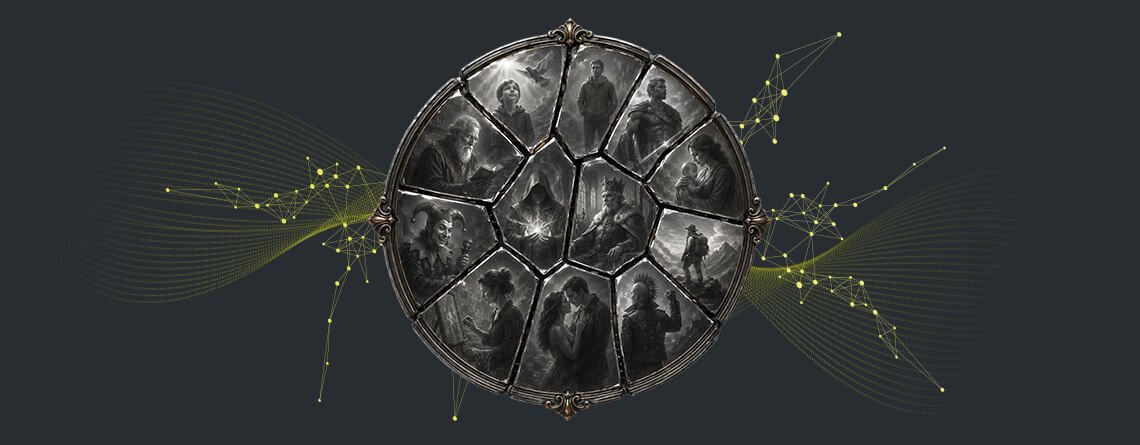
Carl Jung, the Swiss psychiatrist who founded analytical psychology, proposed that beneath our individual experiences lies a collective unconscious, a shared reservoir of memory and instinct common to all people. From this collective unconscious, Jung identified archetypes, universal patterns of behaviour and desire that appear consistently across cultures, stories and generations. This theory offers branding and identity one of its richest foundations, as it suggests that certain personalities are recognisable to us before we ever consciously think about why.
The twelve archetypes, from the Hero to the Innocent, the Sage to the Explorer, each correspond to a basic human desire, such as mastery, safety or freedom. Because these desires are instinctive rather than learned, we do not need to be taught to recognise an archetype when we encounter one. A brand embodying the Explorer, for instance, speaks directly to an audience’s inherent longing for discovery, often before any rational evaluation takes place.
This immediacy connects closely to a well documented tendency in behavioural economics, our reliance on the affect heuristic, the inclination to make judgements based on feeling rather than careful analysis. When a brand successfully embodies an archetype, it triggers this feeling led response almost instantly, allowing connection to form before logical reasoning even begins.
This is precisely why archetypal branding remains so powerful within branding and identity work today. It does not ask an audience to think their way towards trust, it invites them to feel it. A holistic marketing approach recognises the value of this instinctive, emotionally led response, understanding that the fastest and most enduring brand relationships are often built well before a customer consciously articulates why they feel so connected.
THE PRACTICALITY OF BRANDING AND IDENTITY
Yohn's Brand Types as an accessory to Jung
Denise Lee Yohn’s nine brand types offer a valuable evolution within branding and identity thinking, moving beyond the storytelling foundation of Jung’s archetypes and into the practical business of operationalising a brand. Where archetypes describe a personality an audience instinctively recognises, Yohn’s types, including Disruptive, Conscious, Service, Innovative, Value, Performance, Luxury, Style and Experience, describe the strategic stance a business takes across its entire operation, not simply its communication.
Yohn is clear that identifying with one primary type, rather than borrowing traits from several, is essential to maintaining focus and consistency. A business attempting to be simultaneously a Value brand and a Luxury brand, for example, risks confusing both its customers and its own internal decision making. Selecting one type allows every subsequent choice, from pricing to product development, to remain aligned with a single, coherent purpose.
This connects meaningfully to the behavioural economics concept of choice architecture, the idea that the manner in which choices are presented shapes the decisions people ultimately make. A clearly defined brand type functions as an internal choice architecture of its own, guiding employees and decision makers towards options that reinforce the brand consistently, rather than leaving each decision to individual interpretation.
In this sense, a brand type is far more than a communication device aimed at customers. It becomes an operational structure, quietly shaping decisions long before a customer ever encounters the brand directly. A holistic marketing approach values this consistency highly, recognising that every touchpoint a customer experiences, whether service, packaging or pricing, is strengthened when guided by the same clear, well understood brand type.
THE NEW FORMS OF BRANDING AND IDENTITY
Unifying Jung and Yohn
There is a possibility to formulate a meaningful synthesis within branding and identity work, drawing together Jung’s archetypal psychology and Yohn’s operational brand types rather than treating them as separate disciplines. Where Jung explains who a brand instinctively feels like, and Yohn explains what a brand strategically does, Brand Forms unite the two, proposing that character and function should never have been considered apart from one another in the first place.
Each Brand Form pairs a vivid, evocative character description with one of Yohn’s functional types. The Dauntless, for example, brings colourful, human imagery to what Yohn defines as the Disruptive brand, while the Fulcrum brings a similarly rich character to the Service brand, one that quietly carries the weight of an operation without seeking credit. This pairing allows a business to hold a clear operational focus while still communicating with the warmth and immediacy of a recognisable personality.
This union connects closely to the behavioural economics principle of self concept congruity, the tendency for people to favour brands that reflect or reinforce their own sense of identity. When a Brand Form successfully combines vivid character with genuine operational substance, an audience does not simply admire it from a distance, they recognise something of themselves within it. This recognition is what transforms a brand relationship from a fleeting preference into a lasting sense of alignment.
A holistic marketing approach benefits considerably from this united view, recognising that character without function can feel hollow, while function without character can feel forgettable. Brand Forms demonstrate that when identity and operation are woven together with care, the resulting brand feels authentic, dependable and genuinely durable, exactly the qualities that sustain branding and identity over the long term.
THE BRANDING AND IDENTITY JOURNEY
The mechanics powering the framework
Jung’s Archetypes, Yohn’s Types and our new Brand Forms each approach branding and identity from a different angle, yet none of them work in isolation. Jung offers the psychological foundation of instinctive personality, Yohn offers the operational discipline needed to bring that personality to life consistently, and our new Brand Forms reminds us that character and function were always meant to work together.
1. Categorisation

The branding and identity journey begins with categorisation, the psychological process by which the brain files new information into existing mental structures so it can be retrieved quickly. Jung’s archetypes offer twelve such structures, already embedded in the collective unconscious, while Yohn’s brand types and our new Brand Forms offer further categories built for strategic and operational clarity. We must prime our customers to place the brand in their minds almost instantly, and to recall it just as quickly when a need arises. Select a single archetype, brand type, or Brand Form as your primary category, and stress test it by asking new customers, within their first interaction, to describe your brand in one word. If responses vary significantly, your categorisation is not yet clear enough, and messaging should be simplified around the chosen category.
2. Aspiration

Once a category is chosen, a brand must decide where it sits in relation to its customer’s own identity. Rather than simply mirroring who a customer already is, a brand can instead position itself as the identity that customer aspires to grow into. Remember that a brand’s archetype does not always match its audience’s archetype, sometimes the brand’s role is to awaken a desire the customer does not yet openly express. Conduct customer interviews or surveys to understand not only who your customers are, but who they want to become. Use this insight to decide deliberately whether your brand should reflect their current identity or gently invite them towards an aspirational one, and ensure this decision is documented and applied consistently across campaigns.
3. Cognitive Dissonance

A brand identity only holds if what it promises matches what it delivers. When a gap opens between the two, customers experience cognitive dissonance, an uncomfortable tension that arises when belief and experience contradict one another. Over time, this tension erodes trust, regardless of how well an archetype, brand type or Brand Form was originally chosen. Create an internal alignment audit comparing your brand’s public facing promises, found in marketing materials and messaging, against your actual operational standards, such as service levels, product quality or delivery times. Address any gaps found before further campaigns are launched, so that promise and delivery remain in step.
4. Framing

Identity must be expressed through language, and the words chosen carry significant weight in shaping how that identity is perceived, both internally by a team and externally by an audience. Precise framing allows a brand’s identity to be repeated confidently and consistently by everyone who represents it. Develop a short brand language guide defining the key words, tone and phrases that represent your chosen identity, along with terms to avoid due to unwanted connotations. Test this language with a small group outside the marketing team before finalising it, to confirm it evokes the intended impression.
5. Mere Exposure

Repeated, low-friction exposure to a brand builds comfort and trust over time, even without conscious deliberation. Familiarity itself becomes a shortcut for likability and perceived safety. This is the psychological engine behind consistent brand recall. The focus should not be on a single brilliant campaign, but on accumulated, repeated touchpoints that reinforce loyalty. Prioritize frequency over novelty in media planning. A modest budget spread across repeated touchpoints can outperforms a single high-cost, high-creativity burst. Show up in low-stakes, everyday contexts not just high-pressure sales moments, so exposure feels ambient rather than intrusive.
6. Path Dependency

A brand identity is rarely static over its lifetime. As customers, competitors and culture shift, a brand may need to evolve, however this evolution should always be deliberate rather than accidental. Path dependency reminds us that early decisions shape what future evolution is realistically possible, a value brand, for example, is unlikely to convincingly reposition as a luxury brand. Recognising this allows a business to evolve within a sensible, credible range, rather than losing the trust it has already built. Schedule an annual brand identity review, comparing current customer perception, gathered through surveys or social listening, against your intended identity. Use this review to make a conscious, documented decision on whether to reinforce the current identity or evolve it gradually, always remaining within a credible range of your brand’s history and equity.
When marketing and branding professionals explore all three intentionally, rather than favouring one over the others, they gain a fuller, more resilient approach to building an impactful branding and identity journey, one that connects instinctively, operates consistently, and feels authentically human throughout.
THE ADVANTAGE OF BRANDING AND IDENTITY
An achievable and rewarding integrated approach
Looking at well known global campaigns through the combined lens of Brand Archetypes, Types and Forms helps illustrate how branding and identity, when approached with intention, can shape wider cultural conversation. An integrated approach is not reserved for a handful of exceptional global brands. Any marketing or branding professional can begin with a clear, honest understanding of identity, before any strategic or creative decision is made. Branding and identity, approached this way, becomes less of an overwhelming undertaking, and more of a genuinely rewarding foundation, one that brings clarity, confidence and lasting connection to every decision that follows.
Dove’s Real Beauty campaigns illustrate a similarly considered alignment, drawing on the Innocent archetype’s honest, inclusive optimism, while operating clearly within Yohn’s Conscious brand type, and what the Humanitarian form. The emotional resonance here reflects the affect heuristic in action, an instinctive, feeling led response that invited audiences into a wider conversation about representation and self worth. Apple offers a further example, long associated with the Creator archetype, an Innovative brand type in Yohn’s framework, and a Futurist Brand Form. Apple’s consistency across product design, retail experience and communication demonstrates self concept congruity beautifully, customers do not simply purchase a product, they recognise their own creative aspirations reflected back at them.
A distinctive tagline can be copied, a colour palette can be imitated, but a fully integrated identity, built on instinctive psychology, operational discipline and authentic character, is far more difficult to reproduce with any real credibility. This difficulty is precisely what makes the combined approach so effective. Jung’s archetypes ensure a brand connects instinctively, through the affect heuristic, at a feeling led level competitors cannot shortcut simply by observing surface level branding. Yohn’s types then ensure that identity is not just communicated but genuinely operationalised, meaning a competitor would need to rebuild an entire business structure, not merely a marketing campaign, to compete convincingly. And our new Brand Forms bind these two layers together through self concept congruity, creating a brand that customers recognise as an extension of their own identity, a connection that is deeply personal and, as a result, remarkably resistant to being won over by imitation.
For marketing and branding professionals, this is genuinely encouraging news. Branding and identity, built thoughtfully across these three layers, does not simply differentiate a brand for a season or a single campaign. It builds a foundation so coherent, human and consistent that competitors are left, quite rightly, with a considerably harder task than simply designing a new logo.
Published: 28 August 2026
