



Away from hollow transactions towards connection

The AI Innovation
Playbook

Engineering experiences for meaning rather than efficiency

Marketers who embrace AI innovation thoughtfully and ethically are developing the capacity to do something genuinely valuable: to cut through the noise not by adding to its volume but by becoming more precise, more relevant, and more human in how they communicate. AI innovation enables the kind of personalisation at scale that makes audiences feel understood rather than targeted, restoring the sense of meaningful connection that decision fatigue and disengagement have worn away. Used with wisdom and care, it represents one of the most exciting opportunities available to modern marketing practice.

Building systems that reflect humanity

Table of Contents

Balancing AI innovation

CAPABILITY OUTPACING PRINCIPLE

Enthusiasm alone has never built a durable brand. This means that we need to approach AI innovation with a considered method rather than eager adoption for its own sake. What began as basic automation, scheduling posts, segmenting email lists, tagging assets, has evolved into sophisticated, real-time decision making that can adjust bidding, personalise creative, and forecast sentiment within moments. This acceleration means AI innovation now touches nearly every layer of the marketing stack, from the tactical mechanics of campaign delivery through to the strategic architecture of brand positioning itself.

A brand functions as an integrated system, where internal culture, relationship building, performance measurement, and social responsibility must move together. When new and emerging progressive technologies are introduced into only one of these dimensions, say performance marketing, without a framework connecting it to brand voice or customer relationship values, the system becomes unbalanced. Therefore, we must strive to integrate emerging technology into all our branding efforts with care and intention. Capability then races ahead of principle, and brand visibility agents find themselves executing tactics whose long-term implications they have not fully considered.

Consumers respond to consistency, trust signals, and predictable value, all of which are built through repeated, coherent brand experiences. When automation accelerates output without a guiding framework, brands risk introducing subtle inconsistencies, perhaps a chatbot tone that contradicts brand personality, or a hyper-targeted offer that undermines perceived fairness, that erode the very trust heuristics customers rely upon. These small frictions accumulate, and audiences notice long before internal teams do.

The way forward is not to slow down, but to build structure alongside speed. Brand managers who pair genuine curiosity about AI innovation with clear governance, defined brand principles, and behavioural insight will be the ones who harness this acceleration productively. Those who adopt without method leave their brands exposed, not because the technology is flawed, but because capability without principle rarely produces coherence, and coherence is what sustainable brand visibility requires.

AI innovation red flags

THE CASE FOR CAUTION

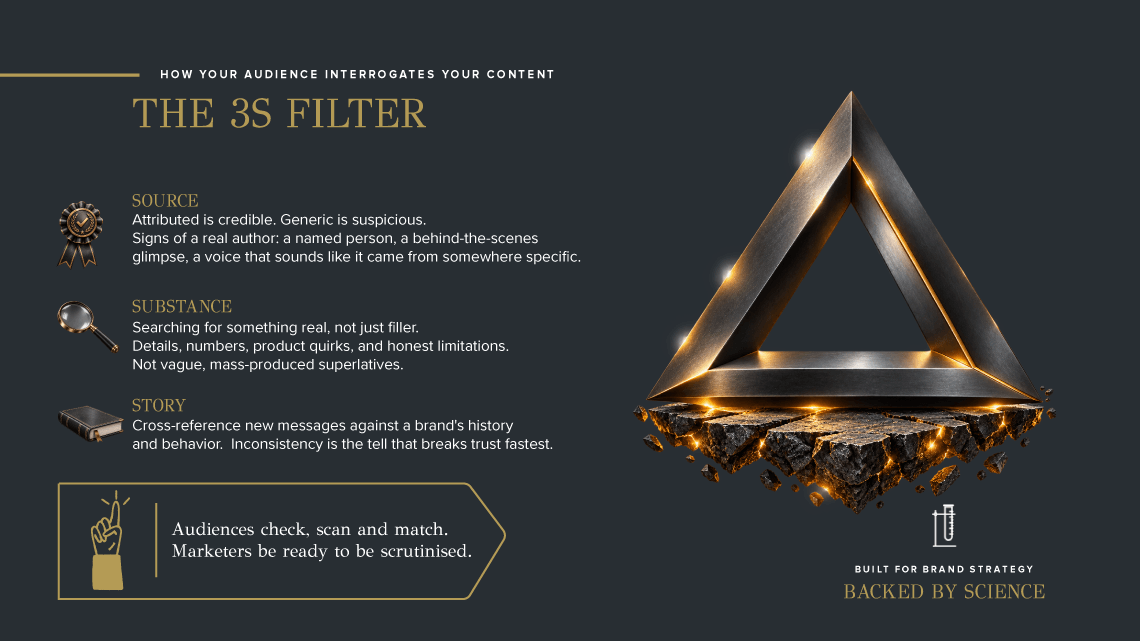
Fast-moving technology tends to leave scrutiny behind, and this is the essential caution that must follow any celebration of AI innovation. As adoption accelerates, audiences have grown considerably more discerning about what they are willing to believe. Where consumers once extended a baseline of trust to polished brand communications, they now actively search for signs of authenticity, questioning whether a message was crafted with genuine understanding or simply generated at scale.

This shift represents a meaningful change in the psychological contract between brand and consumer, and it has several essential components worth naming: heightened scepticism toward generic personalisation, growing sensitivity to tone that feels synthetic, and an increasing tendency to reward brands that visibly demonstrate human judgement behind their AI innovation. Remember that trust is not built at a single touchpoint but accumulated across the entire brand relationship, and this makes it especially fragile when broken.

Consider a brand that deploys AI innovation to generate rapid, hyper-personalised outreach, only for customers to notice repetitive phrasing or emotionally tone-deaf timing. The immediate transaction may still complete, yet the underlying trust heuristic, the assumption that this brand understands me, begins to erode. Behavioural economics tells us that trust operates asymmetrically: it accumulates slowly and depletes quickly, meaning a handful of inauthentic interactions can outweigh months of careful relationship building.

So, a brand’s response to this trust deficit cannot be improvisation. Reactive fixes applied after audiences voice discomfort will always lag behind sentiment, and inconsistent responses only compound the perception of inauthenticity. What brand visibility agents require instead is a deliberate strategy that defines where automation belongs, where human oversight is non-negotiable, and how brand voice remains protected regardless of the technology deployed. Mapping out those guidelines s the natural next step in a conversation like this.

Harnessing AI innovation

WHAT LIES BENEATH

Deeper than automation and efficiency lies a far richer offering, and this is where AI innovation truly earns its place in brand strategy. Many organisations default to measuring success through speed and volume, counting how many assets were generated or how quickly a campaign launched, yet this narrow lens causes them to miss the deeper value available. When applied thoughtfully, progressive methods can surface sentiment patterns that human teams simply do not have the bandwidth to notice, subtle shifts in tone across thousands of customer conversations, recurring emotional undercurrents in reviews, or dissatisfaction that never escalates into a formal complaint yet steadily shapes perception.

We must place genuine importance on internal alignment, insisting that a brand’s promise must match its lived reality, and this is the gap that AI innovation is well suited to reveal. When brand intention, the story a company tells about itself, drifts from actual customer experience, the discrepancy often hides in accumulated small signals rather than dramatic failures. As brand visibility agents we need to strive to attain the analytical reach to detect that drift early, transforming technology from a production tool into an instrument of organisational self-understanding.

By studying the dynamics of consumer behaviour, we know that they rarely articulate their true frustrations directly, relying instead on heuristics, mood, and comparative judgement that surface indirectly through behaviour and language. AI innovation, guided by humans, can be directed toward listening rather than merely outputting, becomes remarkably effective at decoding these implicit signals, offering brand managers a clearer mirror of how their brand genuinely lives in the minds of customers.

What separates brands that harness this value from those that remain stuck measuring speed is not access to superior technology, but the presence of an intentional methodology.

Approaching this new territory with clear questions, like “what do we want to understand about our customers” and , “where might our brand promise be drifting”, transforms the technology from a productivity shortcut into a genuine source of strategic clarity. We should be looking past the dashboard metrics and use AI innovations as a means of listening more closely to the very audiences the brand exists to serve.

AI innovation for strategic value

BUILDING A PLAYBOOK

Believing that AI innovation can be a positive force is a fine starting point, but belief alone does not earn trust. Audiences, whether consumers, small business owners, or entire industries, need to see that commitment translated into action. The five principles below offer a practical route from intention to evidence.

1. Purify Language

AI Innovation Playbook 1 Purify Language

Reduce cognitive load, not content volume. Use AI tools to sharpen messages rather than multiply them, tailoring format and tone to each audience segment so communication feels considered rather than automated. A financial brand, for example, might replace a lengthy terms and conditions email with a single clear paragraph, tested for comprehension rather than word count.

Measure it: track comprehension scores or customer support queries related to confusion. A genuine reduction in “what does this mean” enquiries signals success.

2. Illuminate Processes

AI Innovation Playbook 2 Illuminate Processes

Explain how decisions are made, in language a genuine stranger could follow. A financial services brand might publish a short, plain-language explanation of how its AI-powered recommendations are generated, alongside a simple example showing the logic in action.

Measure it: monitor trust-related survey metrics or Net Promoter Score shifts following transparency initiatives, and track whether customers actually engage with the explanations provided, since publishing information nobody reads is transparency in name only.

3. Abolish Gatekeeping

AI Innovation Playbook 3 Abolish Gatekeeping

Extend AI-powered tools to small and emerging businesses that could not otherwise afford audience intelligence or personalisation capability. This might look like a tiered pricing model, where a small retailer accesses the same quality of customer insight previously reserved for large corporations, at a fraction of the cost.

Measure it: track adoption rates among smaller clients and compare outcomes, such as engagement or conversion improvements, against those previously available only to enterprise budgets.

4. Include Humans

AI Innovation Playbook 4 – Include Humans

Let AI manage scale, and let people manage connection. Automated systems should handle routine efficiency, while genuine empathy and judgement remain with a person whenever a customer relationship matters most. A retail brand, for example, might automate order updates but route any complaint or hesitation directly to a human representative within a set time.

Measure it: monitor response times for escalated queries and customer satisfaction scores specifically on human-handled interactions, since a fast human reply often outperforms a fast automated one.

5. Invite Audiences

AI Innovation Playbook 5 Invite Audiences

Treat audiences as co-creators, not recipients. Use AI to listen as carefully as it speaks, gathering genuine feedback that shapes campaigns, products, or messaging. A community-led campaign, where customers submit ideas that are visibly incorporated into a final product or advertisement, demonstrates this rather better than any slogan could.

Measure it: track participation rates in co-creation initiatives and, more tellingly, the proportion of audience-submitted ideas that are actually implemented, since invitation without inclusion is merely theatre.
Brands that put these five principles into consistent practice will not simply talk about trust, they will be able to point to evidence of it, one measurable improvement at a time.

AI innovation network

PROOF SUPPORTING THE PLAYBOOK

The proposed playbook finds precedent well beyond marketing, across industries AI innovation succeeds when structured by principle, not merely deployed for capability.

Healthcare has long grappled with clinician trust in diagnostic algorithms. Hospitals adopting new technologies for image analysis found that simply improving accuracy was insufficient; adoption only rose once systems illuminated their reasoning, showing clinicians which features informed a result. Since final diagnostic authority remained with physicians, judgement is preserved at the most sensitive point in the journey.

Financial services faced a comparable challenge around gatekeeping. Risk and compliance teams historically hoarded fraud detection insights, leaving customer-facing staff blind to why accounts were flagged. Banks that shared AI innovation outputs across departments reduced friction for legitimate customers while maintaining security, demonstrating that shared visibility strengthens rather than weakens internal controls.

Manufacturing offers a third example through predictive maintenance. Factories once resisted algorithmic recommendations because technical language obscured practical meaning for floor workers. Purifying that language, translating “predictive failure probability” into simple maintenance prompts, increased worker compliance and trust in the system, proving that clarity itself drives adoption.

Emotionally responsive systems, sometimes called Emotion AI or affective computing, is technology that empowers brands to move beyond simple data-driven targeting toward emotionally intelligent engagement that mirrors human empathy. This positions AI innovation as a companion within the journey rather than a cold intermediary. Customer service centres piloting emotion-aware routing, directing distressed callers toward human agents rather than automated menus, invite genuine emotional signals to shape the experience.

Advantages of AI innovation

COLLABORATION OVER SUBSTITUTION

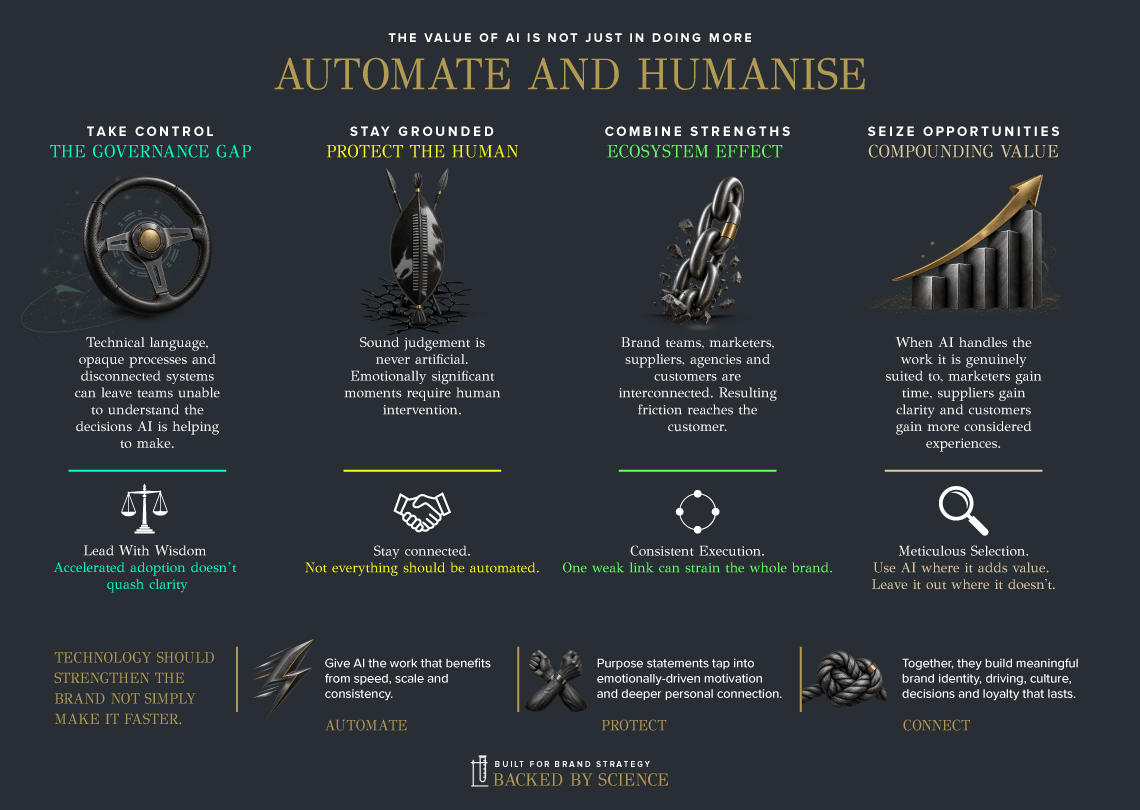
Since brands are adopting AI innovation faster than they are learning to govern it wisely this gap creates real consequences. Language remains needlessly technical, leaving non-specialist teams unable to participate in decisions that will move the brand forward. Processes stay opaque, meaning customers and internal staff alike cannot always tell when automation is at work. Insights remain siloed within single departments, and human judgement is sometimes removed from moments where it matters most.

If challenges go unaddressed, multiple systems suffer. Brand leaders need confidence that their methodologies and tactics reflect and protect brand identity rather than diluting it. Marketers need clarity about which tasks genuinely benefit from automation, so effort is not wasted governing tools that require no oversight. Suppliers and agency partners need shared standards, so that collaborative campaigns remain consistent regardless of which party deploys the technology. Customers, ultimately, need to feel that whatever AI upgrades brands make, that involve customer facing communication or solutions, ultimately serves customer interests through relevance and responsiveness, rather than simply serving internal efficiency.

All of these systems are interconnected, meaning strain on one stakeholder inevitably transmits to another. If a confused marketing team produces inconsistent campaigns, then suppliers struggle to execute coherently, meaning customers ultimately experience undue friction. If trust is eroded anywhere in this chain, is will be slow and costly to rebuild.

The encouraging counterpoint is that strategic value compounds considerably once AI innovation is applied with discernment. When automation handles repetitive, high-volume tasks, and human judgement is preserved for emotionally significant or brand-defining moments, each stakeholder experiences relief rather than strain. Marketers gain time for strategic thinking, suppliers gain clearer briefs, and customers gain experiences that feel considered rather than mechanical.

This selective, principled embrace of AI innovation, present where it adds genuine value and absent where it does not, is the reason that fast-moving technology transforms into a durable, trustworthy collaborator across the entire brand ecosystem.

The future of AI innovation

INTENTIONALITY RATHER THAN IMITATION

Every brand visibility agent, whether steering strategy at the executive level or shaping copy on the ground, is warmly invited to treat this playbook not as a static document to be filed away, but as a living discipline that grows alongside the technology itself. AI innovation will continue to evolve, and the principles explored must be revisited regularly rather than applied once and forgotten. Holistic marketing has always understood that brand health requires ongoing attention rather than a single fix, and behavioural economics reminds us that consumer trust responds to consistency demonstrated over time, not a solitary gesture of good intention.

Every brand visibility agent, whether steering strategy at the executive level or shaping copy on the ground, is warmly invited to treat this playbook not as a static document to be filed away, but as a living discipline that grows alongside the technology itself. AI innovation will continue to evolve, and the principles explored must be revisited regularly rather than applied once and forgotten. Holistic marketing has always understood that brand health requires ongoing attention rather than a single fix, and behavioural economics reminds us that consumer trust responds to consistency demonstrated over time, not a solitary gesture of good intention.

What makes this moment genuinely exciting is that the future of AI innovation need not be defined by imitation, brands copying whichever tactic appears successful elsewhere, but by intentionality, brand visibility agents asking thoughtful questions about where this technology can authentically serve their audiences. This distinction matters enormously, because imitation produces sameness, while intentionality produces distinctive, trustworthy positioning.

This is where we can embrace optimism. Responsible AI innovation, guided by clear principle and genuine curiosity, stands as one of the most powerful tools available to marketers seeking to restore trust in an increasingly sceptical commercial landscape. Used with care, it does not distance brands from their audiences but draws them closer, revealing unspoken needs, correcting drift between promise and experience, and creating space for human judgement where it matters most.

The brands that treat this playbook as a living practice, continually refined as capability grows, will be the ones who help build a more connected, equitable commercial landscape, one where technology and empathy move forward together, rather than technology alone.

Nucleus Vision Digital and Design Legends
A full-service Marketing and Design Agency
hero@nucleusv.com
www.nucleusvision.digital

whatsapp-icon