


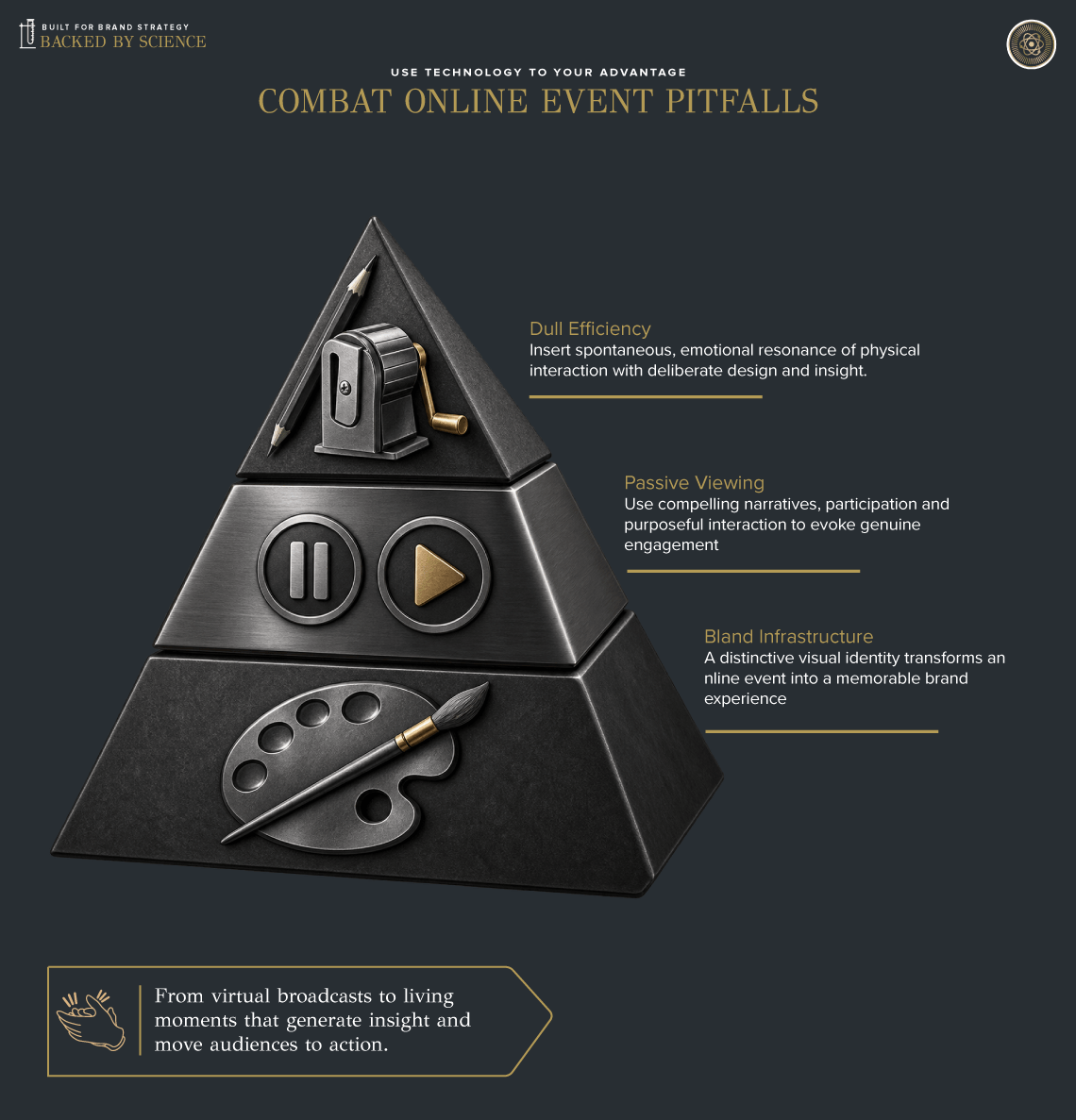

Easy to produce, tough to make meaningful

Navigating
Online Events

Now that barriers to entry have been removed what will we do with this opportunity.

Technology has delivered an unexpected delight. The emergence of online events means that a founder in Lagos, a strategist in Leeds and a designer in Melbourne can now share the same session without a single boarding pass, and the barriers that once made gathering expensive and exclusive have largely dissolved. Yet accessibility has proved a double-edged gift. When joining doesn’t carry a heavy cost, then commitment carries even less. The very ease that fills registration lists also invites distraction, passivity and a polite, half-attentive drift towards the nearest open tab.

If anyone can attend from anywhere, what’s the meaningful motivator?

Table of Contents

Online Events Need More Than Attendance

COMMITTMENT VS ENGAGEMENT

What are online events really for? At their best they exist to solve a simple problem: how can a brand gather people around ideas, build trust at scale and turn attention into action, without the cost and geography of a physical venue? Technology has answered the logistics brilliantly. But, how far are we from understanding the psychology that goes into building it. The challenge harder than it seems to be on the surface.

Behavioural scientists call it the intention-action gap. People sincerely intend to show up, learn and act, yet intention evaporates when follow-through requires little commitment and distractions are plentiful. Industry benchmarks routinely show that a substantial share of registrants never attend at all. Clicking “register” costs almost nothing, so it signals almost nothing.

Before an event even begins curiosity must be nurtured or it wilts. During, the event competes with inboxes, notifications and a dozen restless browser tabs. After the date has passed, the screenshots have been shared and the quotes have been posted to social stories the momentum decays rapidly. So, clearly, we need something that invites the next step.

Seen this way, online events are not a single moment in time. It is a behavioural journey. A registration is not a relationship. A view is not engagement. Attendance is not action. We need to have a clear picture of our customers and know exactly what to do to get their attention. The brands that succeed treat every stage as a deliberate nudge towards the next, designing each touchpoint around what people will feel, do and remember long after the stream ends.

Understanding The Online Events Challenge

DECONSTRUCTING ENGAGEMENT

Engagement is a suitcase word in the world of online events, and once unpacked it reveals a sequence of distinct challenges that each feed the next. The journey begins with attention, the scarcest currency of the modern screen. As Herbert Simon observed, “a wealth of information creates a poverty of attention”, so every event must first be discoverable, then relevant and distinctive enough to be chosen over the inboxes and feeds jostling for the same glance.

Yet winning attention guarantees very little, because registration to online events costs almost nothing and cheap commitments are easily abandoned. Because of a complex web of individual bias people persuade themselves to trade tomorrow’s learning for today’s urgent task. Meanwhile weak perceived value, awkward timing and small moments of friction continue to widen the gap between intending to attend and actually arriving.

Even arrival is not the finish line, since watching is not the same as participating. Passive viewers drift, but polls, questions, workshops, networking and co-creation cultivate social presence, that reassuring sense that others are genuinely there. Playful gamification raises the stakes, and contribution gradually converts spectators into stakeholders. Participation matters because memory is gloriously selective. Humans judge experiences by their most intense moment and their ending, we are also more likely to remember what we actively produce. Taking these two behavioural observations into account we can see how emotion, narrative, novelty and personal relevance become the glue that makes an experience stick.

Even arrival is not the finish line, since watching is not the same as participating. Passive viewers drift, but polls, questions, workshops, networking and co-creation cultivate social presence, that reassuring sense that others are genuinely there. Playful gamification raises the stakes, and contribution gradually converts spectators into stakeholders. Participation matters because memory is gloriously selective. Humans judge experiences by their most intense moment and their ending, we are also more likely to remember what we actively produce. Taking these two behavioural observations into account we can see how emotion, narrative, novelty and personal relevance become the glue that makes an experience stick.

We also need to design the online events to shape behaviour long after attendees have logged off. Without deliberate follow-up goodwill erodes, whereas community, content ecosystems, thoughtful nurturing and reciprocity keep relationships warm enough to spark advocacy and purchase.

This is why the most valuable online events refuse to be mere calendar entries. Each one can ripple outward into content that feeds a community, relationships that generate data, and authority that eventually opens commercial opportunity, transforming a single broadcast into a compounding engine of brand value.

Online Events Have A Job To Do

THE ECOSYSTEM OF NEEDS

Nobody wakes up wanting to attend online events. They wake up wanting a promotion, a sharper idea, a useful contact or simply the reassurance that they are not falling behind. The event, indeed any product, service or experience that we offer our audiences, is merely a vehicle that might deliver that need. Clayton Christensen called this “the job to be done”, and it explains why marketers so often misread their audience.

Place the attendee at the centre and the tension becomes clear. Marketers want registrations, dwell time and qualified leads, while attendees want relevance, recognition and a worthwhile return on the scarce time they have donated in the hopes of getting a worthwhile return on that investment. Speakers crave visibility and credibility, sponsors seek attention that converts into pipeline, and the host brand hopes to accumulate authority. Meanwhile the platform wants activity and retention, and the organiser juggles every one of these expectations at once.

These objectives overlap wherever attendee value is created, because an engaged audience rewards everyone simultaneously. They compete wherever someone extracts value before offering any, as when a sponsor interrupts learning with a sales pitch or a speaker performs rather than helps. Loss aversion makes attendees acutely sensitive to such moments, since wasted time feels far heavier than useful time feels light.

So, now we understand that we cannot start from a place where what organisers want people to do is the driver. Successful online events begin with what people want for themselves. Everyone arrives wanting something different, and the art lies in designing an experience generous enough to satisfy each motive while nudging all of them gently in the same direction.

A Skeleton For Successful Online Events

UNLIKELY TEACHERS

Television writers have long understood something that the organisers of online events often forget. An unfinished story lingers. The Zeigarnik Effect suggests we remember incomplete tasks more vividly than completed ones, which is why cliffhangers keep us returning week after week. Translated into an event context, a pre-event teaser series could end each instalment with an open question that only the live session resolves, turning anticipation into a gentle itch that attendance finally scratches.

Education contributes an equally useful insight. The flipped classroom moves passive content outside the lesson so that precious live time is reserved for discussion and problem-solving. Applied here, recorded keynotes could arrive beforehand, freeing the live hours for workshops, debates and spirited hot-seat questioning. Retrieval practice adds another layer, since short quizzes after each session strengthen memory far more effectively than simply rewatching the recording.

Gaming, meanwhile, is a masterclass in voluntary effort. Players cheerfully spend hours on challenges nobody forced upon them because games offer clear goals, visible progress and the camaraderie of guilds. So, why don’t online events adopt a similar quest structure? Attendees could unlock badges by attending, contributing and connecting, while small peer teams give everyone a reason to return for one another rather than merely for the agenda.

Stitch these principles together and a new kind of experience emerges, part serialised drama, part seminar and part adventure. The most memorable online events of the future may look less like conferences and more like a season of television that everyone gets to co-write.

Designing Effective Online Events

EXPERIENCES NOT LECTURES

Let’s build something people want to be part of. Webinars are built to transmit information, whereas digital experiences are built to transform the people inside them. Shifting the way we organise our online events from one to the other means adopting an architectural mindset. Shaping every room with the intention of engaging with, and providing value to the people who move through it.

1. Earn Intention

Effective Online Events 1 Intention

People commit to what feels personally relevant, so lead with a problem, ambition or opportunity that a specific audience genuinely cares about. Write the event promise as one sentence stating who it is for and what they will gain, then test it with five real customers. Ask every registrant to share a personal goal, because small commitments make follow-through considerably more likely.

2. Invite Participation

Effective Online Events 2 ParticipationOwnership grows from involvement. Take a page from global home furnishings giant, IKEA, and remember that people value what they help to build. Audit the running order so that no more than ten minutes pass without a moment where attendees can question, vote, choose, create or compete. Hand the audience genuine influence, such as selecting a workshop topic, and spectators quickly become co-authors.

3. Engineer Memories

Effective Online Events 3 MemoriesThe peak-end rule suggests experiences are judged by their high points and their finale. Deliberately design at least one surprising peak per session, whether a live demonstration, an unexpected guest or a playful challenge. Weave practical examples into stories rich with personality and contrast, then close with an emotionally resonant ending rather than a hurried goodbye that lets the energy leak away.

4. Cultivate Connection

Effective Online Events 4 ConnectionA chat box is not a community, and belonging rarely happens by accident. Introduce small breakout groups built around shared challenges, each with a simple prompt that helps people discover common ground quickly. Our identities are tied to our social groups, so people tend to invest more when they feel a sense of belonging. Give each cohort a name, a purpose and a reason to reconvene.

5. Deliver Value

Effective Online Events 5 ValueAttendees should leave thinking less about how interesting the session was and more about what they can now do. Pair every keynote with a worksheet, template or recommended next step, so insight has somewhere practical to land. Reduce friction by delivering these resources within the hour, while motivation remains warm and intentions have not yet been buried by inboxes.

6. Extend Relationships

Effective Online Events 6 RelationshipsThe best online events are beginnings rather than destinations. Reciprocity means generous value invites continued engagement, so map the thirty days that follow, including a community space, distilled content and further learning. Offer one clear, low-effort next step, whether joining a conversation or booking a call, because momentum is far easier to sustain than to rebuild from scratch.

Assembled together, these principles form a practical framework that carries people from intention to participation, memory, connection, action and advocacy. Marketers who plan online events against each stage in turn will find they are no longer simply filling seats, but cultivating a community that returns willingly and brings others along.

Online Events Case Study

JACOB CASS’ BRAND BUILDERS SUMMIT

You have the blueprint. Now, do you want to know if these principles for creating online events really produce results. Jacob Cass deliberately designed beyond the broadcast with the Brand Builders Summit 2026. The four-day virtual summit brought together brand leaders across strategy, design, marketing and business, built around the theme Ascent to Mastery. But the numbers tell an equally interesting story.

Brand Builders Summit: Numbers to Know

• Thousands of attendees joined live
• Attendees represented 100+ countries
• 48+ global speakers
• Almost 44 hours of recorded content
• More than 432,000 words of shared insight
• Five live panels and seven practical workshops
• More than $10,000 in prizes and giveaways
• A 9.8/10 average attendee rating so far
• 100% of survey respondents said they would recommend the summit to a friend

The learnings in these results are invaluable.

First, start with a problem people actually care about. The summit was one of the rare online events that recognised a genuine tension in the creative industry and its proposition responded by helping brand builders become more strategic, distinctive and commercially valuable. Then, design for participation, not just consumption. The audience wasn’t simply given content. It was given multiple opportunities to interact with it, the rest of the audience, and the experts delivering it.

Now, make the event bigger than the event. The summit connected into the Brand Builders Alliance community, while its enormous volume of content was subsequently distilled into practical after-the-fact consumables. The experience could therefore continue delivering value after the live sessions ended.

The takeaway cannot be overstated. Don’t design your experience around what you have to say. Design it around what your audience needs to experience, do and become. An online event can be far more than a digital venue. Done strategically, it can become a content engine, community builder, authority platform and behavioural journey, with the event itself acting as the catalyst rather than the entire experience.

Online Events Are Easy

MAKING PEOPLE CARE IS HARD

The future of online events belongs to to brands who shift from mere information sharing to experiences worth staying for and an understanding that building those experiences requires an understanding of behaviour. The coming years will only sharpen the challenge of creating virtual spaces where true engagement is fostered. AI and digital platforms will keep making events faster to build, cheaper to run and simpler to scale, which means polished production will soon become the minimum expectation rather than a distinguishing feature. When everyone can broadcast beautifully, broadcasting alone will set nobody apart. The differentiator will increasingly be what technology cannot conjure on its own, namely relevance, meaning, connection, creativity, community and genuine human intention.

That shift demands a new definition of success for online events. Registration counts and view totals are comforting numbers, but they measure presence rather than progress. Far more revealing are the questions that are asked after an experience, and the weight those answers hold. Did people contribute? Did they connect with one another? Did they leave with something useful, and did they return for more? Designing around behaviour rather than broadcasting content turns these questions from afterthoughts into the blueprint itself.

So here is our invitation to marketers, brand managers, CMOs and founders alike. Stop asking how to build an online event and start asking how to build something people genuinely want to be part of. Treat every touchpoint as a nudge, every session as a chapter and every attendee as a potential collaborator rather than a statistic.

The future of online events is not about squeezing more people into the room. It is about giving them a reason to stay, participate, connect and keep coming back, long after the screen goes dark.

Updated: 6 Nov 2026

Nucleus Vision Digital and Design Legends
A full-service Marketing and Design Agency
hero@nucleusv.com
www.nucleusvision.digital

whatsapp-icon