



Table of Contents
Purpose statement roots
ANSWER THIS SIMPLE QUESTION
The question “what do you sell” invites an easy answer because it lives in the rational, operational domain of business. Products, features, and price points are tangible and measurable, so teams can answer with confidence and precision. The question “why do you exist” invites hesitation because it demands emotional clarity rather than operational fact, and many organisations have simply never done the internal work required to answer it with conviction. This is where a purpose statement becomes essential, as it forces a business to articulate its deeper reason for being rather than leaving that reason implicit and, therefore, inconsistent across departments.
Humans rely heavily on heuristics, mental shortcuts that help them make quick judgements about trustworthiness, and a brand that cannot articulate its purpose coherently sends fragmented signals that unsettle these shortcuts. Conversely, when a purpose statement is genuinely lived, it reduces the cognitive effort a customer must expend to trust the brand, since consistency itself functions as a proxy for reliability. This aligns closely with the principle of social proof, wherein people trust brands that others already trust, and that trust compounds more readily when the underlying purpose feels stable and sincere rather than opportunistic.
This connective tissue must run through internal marketing, relationship marketing, and integrated marketing simultaneously, rather than existing solely as an external-facing slogan. A decorative purpose statement, crafted purely for campaigns, tends to fracture under scrutiny, whereas a living purpose statement threads consistently through hiring decisions, product development, and customer engagement alike. Marketers would therefore be wise to treat the purpose statement not as a polished finishing touch, but as the architecture beneath every decision the brand makes, ensuring that loyalty is earned through demonstrated coherence rather than declared aspiration.
The purpose of a purpose statement
START WITH WHY
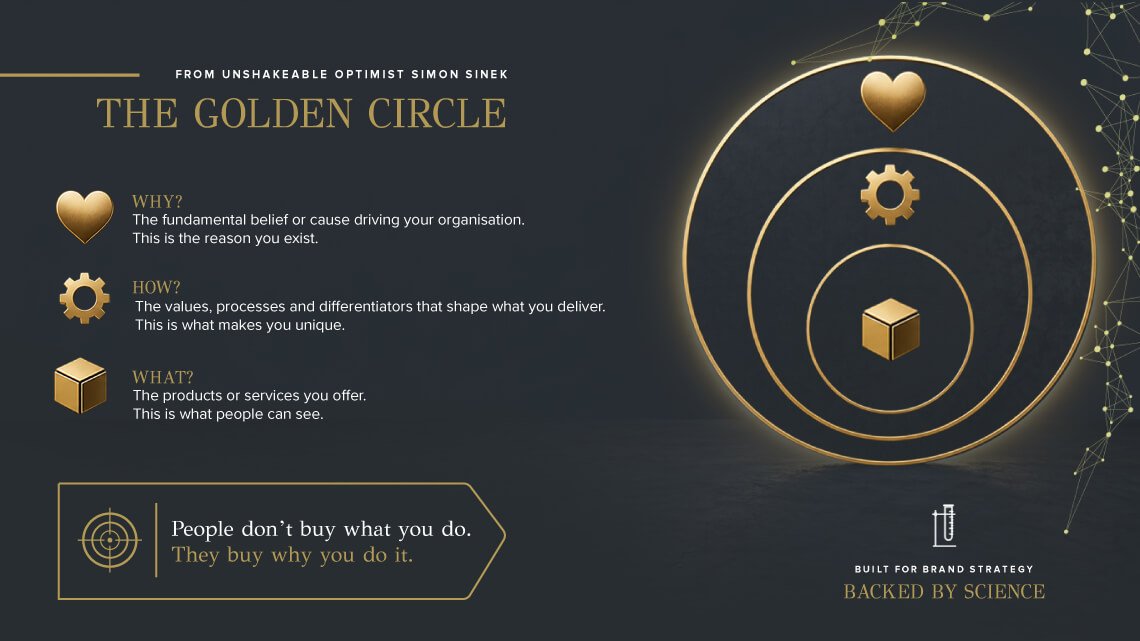
Simon Sinek’s Golden Circle offers a wonderfully simple yet profound structure for understanding brand communication, comprising three concentric layers.
The outermost circle, What, represents the products or services a business offers, and this is invariably the layer most organisations lead with, since it is the most visible and easiest to quantify. The middle circle, How, describes the processes, values, or differentiators that shape delivery, often expressed through claims of quality or innovation. The innermost circle, Why, represents the fundamental belief or cause driving the organisation, and this is precisely the circle most brands forget to draw, largely because it requires uncomfortable introspection rather than straightforward description.
Many businesses simply never pause long enough to ask why they exist beyond generating revenue, so the Why remains undefined by default rather than by choice.
This omission matters considerably, because a purpose statement rooted firmly in the Why is what generates genuine emotional resonance with audiences. We are all aware that decision-making is rarely as rational as traditional marketing once assumed. Emotional processing frequently precedes and shapes rational justification, meaning customers often feel an affinity toward a brand before they consciously evaluate its features. Starting communication with Why, rather than What, therefore taps into this emotional pathway first, allowing the audience to form an identity-based connection before rational comparison even begins.
Sequencing like this becomes particularly powerful, as it unifies internal culture and external messaging around a shared emotional truth rather than a shifting list of features. A well-articulated purpose statement, built from the Why outward, therefore becomes far more resilient against competitive rational comparisons, since customers who feel connected to a brand’s belief system are considerably less swayed by marginal differences in price or specification than those who were persuaded through feature-based logic alone.
Crafting your brand purpose statement
FROM BONES TO IMBUED
Developing a formal guide to crafting a purpose statement matters because purpose without process tends to dissolve into good intentions rather than actionable strategy. Marketing leaders often understand intellectually that purpose drives loyalty, yet without a structured pathway, the exercise becomes vague, inconsistent, and vulnerable to abandonment under commercial pressure. A guide transforms aspiration into discipline, ensuring the resulting purpose statement is not accidental but deliberately engineered to withstand scrutiny and endure market change.
1. Anatomise

Cut through the fat, uncover your bones. We should begin by examining five building blocks in isolation before attempting synthesis. The Cause identifies the fundamental problem worth solving, while the Impact clarifies the tangible change sought for stakeholders. The Stakeholders themselves must be named specifically rather than abstractly, and the Values should be interrogated for authenticity rather than aspiration. Finally, the Unique Role forces honest acknowledgement of what only this particular brand can credibly deliver, answering plainly what problem the business exists to solve and who genuinely feels the difference.
2. Anthologise

Collect the most useful stories already being told. Now, actively seek cross-generational perspectives, since Gen Z and Gen Alpha employees and customers often carry markedly different expectations of authenticity than earlier generations. Anonymous internal surveys and AI-assisted sentiment analysis can surface more candid employee feedback than traditional interviews allow. Uncomfortable revelations should be welcomed rather than avoided, as these gaps between stated intention and lived reality often reveal precisely where the purpose statement needs strengthening.
3. Bricolage

Assemble something new with the insights gathered. With raw material collected, findings should be mapped against Sinek’s Golden Circle, clarifying Why, How, and What in sequence. Teams can then complete the sentence,
“We exist to __________ so that __________,”
Remember to resist grandiosity in favour of honesty. The resulting purpose statement should explain the brand’s reason for existing within a single breath.
4. Interrogate

Push your statement until only the truth remains. The draft must now be tested rigorously. Ask whether it reflects genuine culture, whether employees recognise themselves within it, and whether customers can trust the brand on its basis. A useful discipline involves imagining public challenge tomorrow and asking whether sufficient evidence exists to defend the statement convincingly.
5. Permeate

Make it a living force, not a framed portrait. Finally, the purpose statement must be woven into hiring, training, and internal culture, alongside messaging, product decisions, and public relations externally. Accessible to every department, and the sentiment of which must be ever-present, from onboarding materials and leadership training, to internal knowledge hubs. The statement should all reference it consistently, ensuring anyone across the organisation can retrieve and apply it with confidence.
Now that your purpose statement is alive, the work does not stop there. Rather than remaining fixed, it should function as a compass, revisited periodically to confirm continued relevance. This one of the keystones of your business and it must be treated as an evolving practice rather than a finished artefact, revisited, refined, and reaffirmed as markets shift and organisations grow. Purpose that remains static risks becoming irrelevant, whereas purpose that continues evolving becomes genuinely alive within the organisation.
Your purpose statement and the trust equation
DO CUSTOMERS ACTUALLY BELIEVE YOU?
Consumers have grown increasingly sceptical of ethics that appear performative because behavioural conditioning has taught them to distinguish rhetoric from evidence. Repeated exposure to campaigns claiming social responsibility without corresponding action has heightened public sensitivity to inconsistency, meaning audiences now instinctively test brand claims against observable behaviour rather than accepting messaging at face value.
This scrutiny connects directly to the Interrogate phase of building a purpose statement, wherein marketers must ask whether their stated commitments could withstand public challenge if questioned tomorrow. Corporate social responsibility, therefore, cannot function as a public relations accessory applied after strategic decisions are made, since customers now treat it as a genuine litmus test of whether a purpose statement reflects lived values or aspirational branding.
Once a customer detects even a small inconsistency between stated purpose and demonstrated action, they become primed to notice further discrepancies, and trust erodes considerably faster than it was built. Conversely, when corporate social responsibility initiatives align coherently with a brand’s purpose statement, each action serves as tangible proof that reinforces belief rather than merely requesting it. This transforms responsibility from a defensive compliance exercise into an active trust-building mechanism, one where customers themselves become validators of authenticity.
These considerations must be at the forefront of our intentions from the earliest stages of strategic planning, integrated fully into operational and cultural decision-making rather than treated as a communications afterthought. When corporate social responsibility genuinely mirrors a brand’s purpose statement, loyalty deepens meaningfully, as customers feel their trust has been placed wisely rather than persuaded superficially.
From purpose statement to purposeful action
BEYOND THE PAGE
A living purpose statement reveals its true strength not in the boardroom, but in unexpected corners of the business where nobody is watching for compliance. Consider hiring decisions, where interview panels increasingly assess candidates against alignment with organisational purpose rather than qualifications alone, ensuring new employees genuinely embody the values described within the statement rather than merely tolerating them. Consider also product development, where seemingly minor choices, such as packaging materials or supplier selection, can either reinforce or contradict the brand’s stated reason for existing.
These decisions rarely appear in external campaigns, yet they accumulate into a coherent pattern that customers eventually perceive, whether consciously or intuitively. Pattern recognition matters considerably, since humans naturally seek consistency when evaluating trustworthiness. A purpose statement functioning as compass, rather than décor, therefore permeates decisions that seem entirely unrelated to marketing, from workplace policies to procurement choices, and each aligned decision compounds credibility incrementally rather than instantaneously.
This same compass becomes particularly powerful when informing audience-focused brand messaging and communications. Rather than crafting campaigns reactively around trends or competitor activity, marketers can return continually to the purpose statement as a filtering mechanism, asking whether proposed messaging genuinely reflects the organisation’s deeper Why. This ensures communications feel less like isolated creative bursts and more like chapters within a coherent, ongoing narrative, which audiences instinctively find more trustworthy.
Consistency across seemingly unrelated departments becomes the very evidence that separates authentic purpose from decorative language, proving that a purpose statement, properly permeated, shapes culture and communication simultaneously rather than existing as two disconnected exercises within the same organisation.
What your purpose statement is not
PURPOSE IS NOT A COSTUME
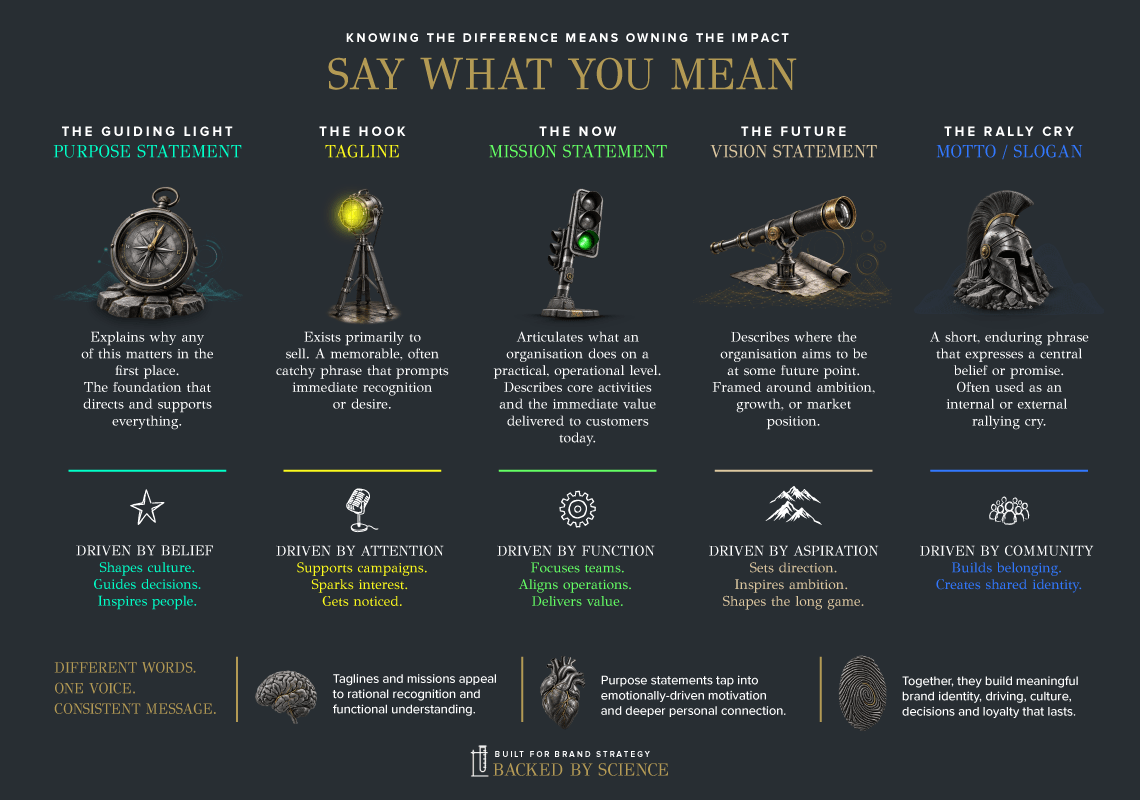
A purpose statement occupies a distinct category entirely separate from mottos, taglines, mission statements, and vision statements. Even though many of us frequently conflate the four, each serves a different function across the organisation.
- A tagline exists primarily to sell, functioning as a memorable, often catchy phrase designed to prompt immediate recognition or desire, such as a rallying cry attached to a specific campaign or product launch.
- A mission statement, by contrast, articulates what an organisation does on a practical, operational level, typically describing core activities and the immediate value delivered to customers today.
- A vision statement extends this thinking forward, describing where the organisation aims to be at some future point, often framed around ambition, growth, or market position.
- A purpose statement, however, answers a fundamentally different question altogether, explaining why any of this matters in the first place, beyond commercial activity or future ambition.
Taglines and mission statements operate largely within external and operational marketing respectively, while a purpose statement must permeate internal marketing as well, shaping culture, hiring, and daily decision-making long before it ever reaches a customer-facing campaign. From a behavioural economics perspective, this distinction also explains differing emotional impact. Taglines and missions appeal primarily to rational recognition and functional understanding, whereas a purpose statement taps into deeper identity-based motivation, the very mechanism behind lasting loyalty rather than momentary recall.
So, we must avoid treating a purpose statement as simply a more poetic version of a tagline. It should instead be understood as the philosophical anchor beneath everything else, the reason a mission is pursued and a vision imagined, ensuring that no matter how language evolves externally, the underlying Why remains stable, sincere, and genuinely lived.
Committing to a meaningful purpose statement
YOUR TURN
To every marketer, branding expert, and professional entrusted with the identity and reputation of their brand, the moment has arrived to stop guessing. Too many organisations continue operating on assumptions about their own Why, mistaking a polished tagline or an ambitious vision for genuine purpose, when in truth these are merely fragments of a larger, unexamined whole.
A powerful purpose statement offers considerably more than emotional resonance in a campaign. It becomes a latent driver for a more expansive visual identity system, informing colour choices, typography, and tone with genuine coherence rather than arbitrary preference. It shapes what belongs within an internal newsletter, guiding leaders toward stories that reinforce culture rather than merely filling space. It touches procurement decisions, hiring panels, and product development with equal authority, proving that purpose, once properly anatomised, becomes the connective tissue behind every meaningful choice a brand makes.
Clarity transforms scattered initiatives into a unified expression of identity, and from a behavioural economics perspective, this consistency compounds trust incrementally with every aligned decision a customer observes over time.
So the invitation extends beyond crafting a single sentence. It is an invitation to transition from statement to movement, allowing purpose to ripple outward through every department, every decision, and every interaction, until an entire organisation moves together, guided not by guesswork, but by a clearly anatomised, deeply lived, and continuously evolving purpose statement.
Published: July 18, 2026
Updated: September 25, 2026
